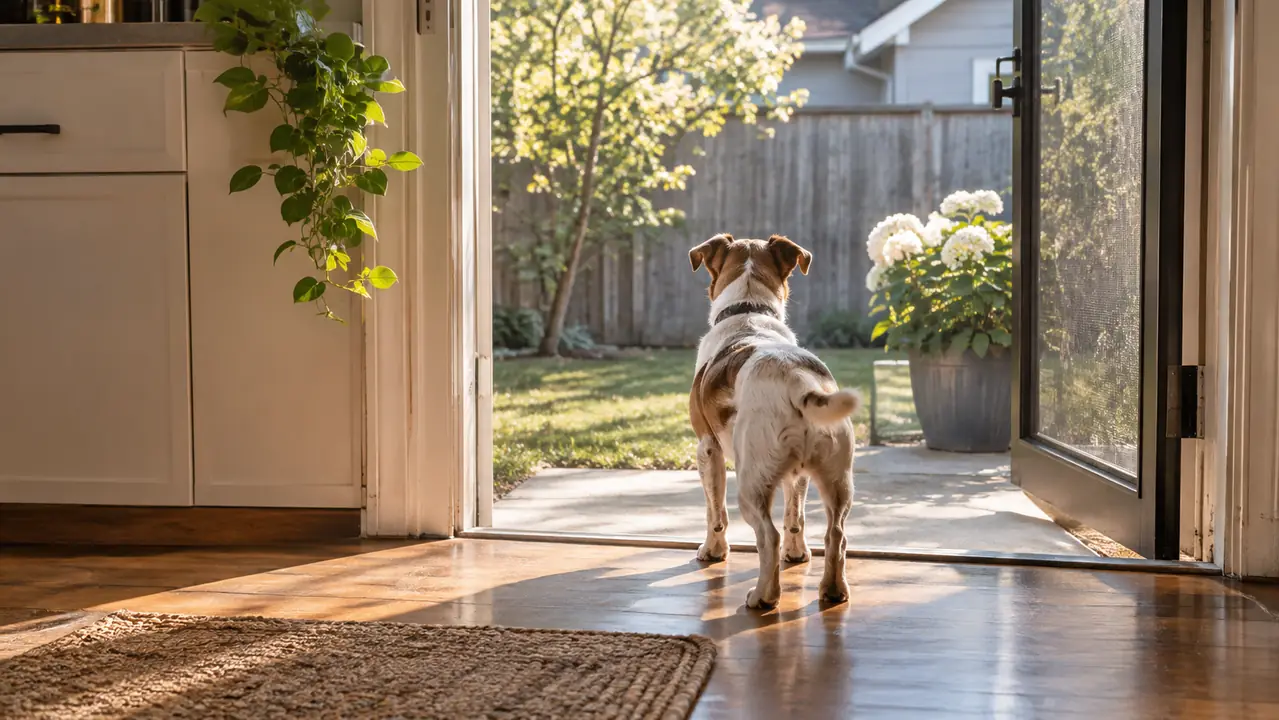
Nine days after I brought Pip home from the county shelter, a trash truck banged at the end of the street and he backed straight out of his collar and ran. He is a terrier and Chihuahua mix, thirteen pounds, about four years old, and he was gone before I had the leash sorted in my hand. He got two houses down and hid under Marge's hedge. Ten minutes and one slice of cheese later I had him back, and he was not hurt. I stood in my kitchen afterward with my heart going and understood something I had not understood an hour earlier: I had a dog who could vanish out of a flat nylon collar in the length of one driveway.
That night, around eleven o'clock, I sat at the kitchen table and ordered three things: a harness, a Furrigo AirTag collar in size S, and a single AirTag in its own separate order. All three arrived within the same week. Eleven months on, the Furrigo collar is the only collar he owns. It carries his license and his ID tag, and it stays on him in the house, not just on walks. What follows is the order I would do it in if I had to start over, including the parts I got right by luck as much as by sense. Furrigo is the brand I landed on. A well fitted collar with a closed tag holder from any decent maker does the same job.
The collar he has not had off in eleven months
Ordered the night of the escape and still on his neck. The AirTag drops into a closed case, the case screws shut with the little screwdriver that comes in the box, and the whole thing shrugs off rain. The AirTag itself is sold separately, so put one in the cart at the same time.
Amazon Check Today's Price on Amazon →Step 1: Measure his neck at the kitchen table before you order
I used the tape measure from the kitchen drawer. Pip came out at seventeen inches around the chest and eleven inches around the neck. That second number is the one that matters for a collar, and it is the one people guess at. Do not guess. A collar an inch too big is a collar a scared dog can back out of, which is the whole story of my first nine days with him.
The Furrigo size S is built for necks from 10.6 to 13.6 inches, and the collar itself is 12.1 inches long. Pip's eleven inches sits toward the low end of that, which leaves me room to adjust as his coat thickens in winter. If your dog measures near the top of a size, take the next size up rather than squeezing him into the small one. And treat his weight as a rough check only. Thirteen pounds with a narrow neck and thirteen pounds with a thick one are not the same order.
Two things I noticed when it arrived. The strap is leather and nylon, so it has some body to it and does not roll up like a ribbon. And the closure is an ordinary buckle, which I can work one handed in the dark. I could not have said that about the plastic clip on the collar he came home in.
Step 2: Fit it in the house, then try to pull it off over his ears
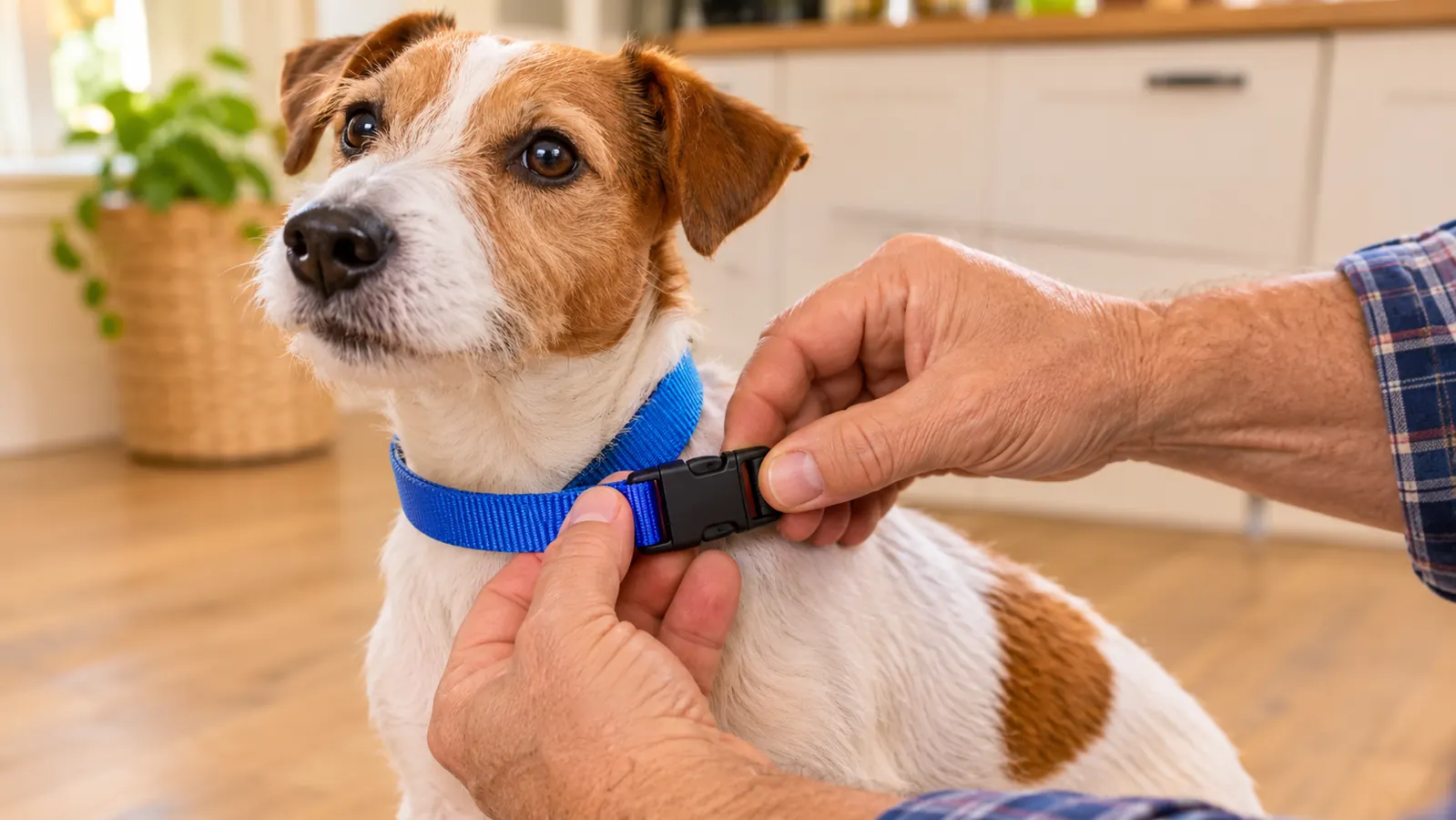
I fitted it at the kitchen table with Pip standing on an old towel, and then I did the check that has kept us out of trouble ever since. I tried to ease the collar back over his ears. It would not go. That is the fit I want, and it is exactly the fit the flat collar failed. On the night of the escape, that collar slid over his head with almost no pressure at all.
Snug is not the same as tight. I can still slide one finger under the strap, and there has never been a red mark on his neck when I check. I check every couple of weeks and after every wet walk, because a strap that was right in December is not automatically right in June. If you can get two fingers under it comfortably, it is too loose for a nervous dog. If you cannot get one, loosen it a notch.
Step 3: Load the AirTag before the collar goes on the dog
The AirTag does not come in the box. I bought mine separately the same night, and I would have been irritated to find that out at the mailbox, so consider this your warning. The collar ships with a small screwdriver, and the holder is a closed case rather than an open sleeve with a tracker sitting loose in it. I have opened the case exactly once, to put the AirTag in.
That closed case turned out to matter more than I expected. It is rated IP68 waterproof and dustproof, which covers rain, wet grass, and a walk that ends wetter than it started. I hand wash the collar with mild soap and let it air dry, and the rest of the time a damp cloth does the job. The tracker inside has stayed dry through all of it.
One more thing about that case. Because it screws shut, it does not pop open when he rolls on the rug or shoves his head under the fence line to sniff at something. This one has not lost anything.
Step 4: Test it from somewhere you actually go
Here is the plain truth about an AirTag, and I wish someone had said it to me in December. It is not a GPS collar. It does not draw a live line of dots on a map while your dog runs. It reports a location when it is near Apple devices that happen to be passing, which in a neighborhood with houses close together is most of the time, and out on a bike path with nobody around is close to never. I bought it knowing that, because Pip is not a dog who goes hiking.
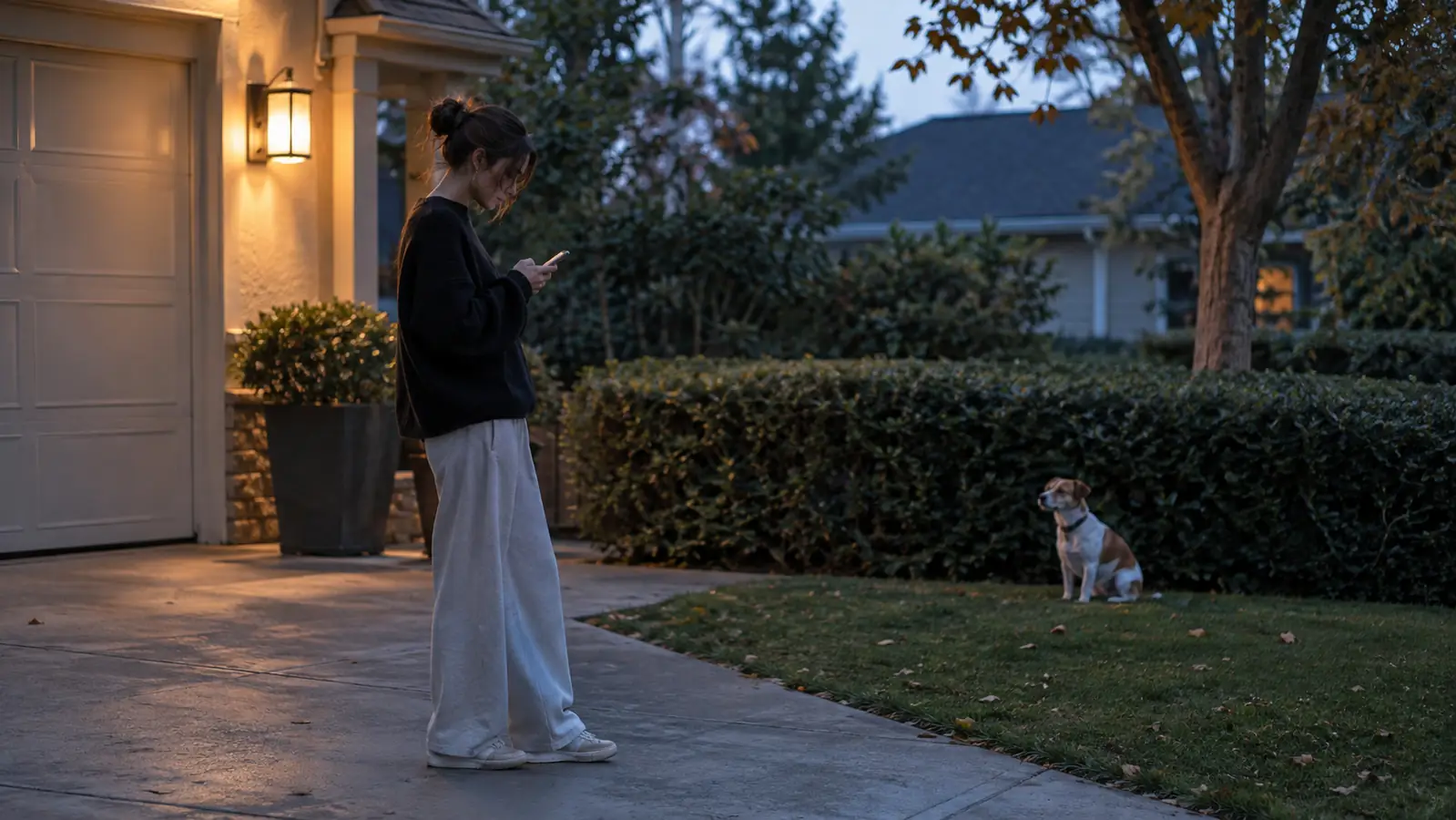
I have tested it three times. Twice from the library parking lot on a Tuesday morning while he was home, and once from the grocery store. Each time the dot appeared within a couple of minutes and put him at my house. A couple of minutes is the honest number. It is not instant, and I would not pretend otherwise.
And here is the part that matters most: in eleven months I have never once needed it to find him. Not once. That is the real review. If your dog bolts regularly, or you walk off leash in open country, buy a subscription tracker instead and skip this whole idea. If your dog is like mine, a small anxious fellow who got loose once at the back steps and has not done it since, this is enough, and it needs no subscription to keep working.
Step 5: Clip the leash to a harness, never to this collar
The collar holds his license, his ID tag, and the tracker. It is not what I hold him by. That is the harness, ordered the same night, and the leash clips to the harness every single time we go out the back door. He has never slipped it. Eleven months, two walks a day, and not one incident.
For the first few weeks he froze when I put it on, and I stood in the hall waiting him out. By March, roughly three months in, he had mostly stopped lunging at noises. I am not going to tell you a harness calms a nervous dog, because it does not. What it does is mean that a dog who cannot back out of his walk is a dog who cannot run.
The harness hangs on a hook by the back door and nowhere else. On the fourth of July, with the fireworks, he stayed in, so the harness stayed on the hook all evening. He spent it in his bed in the bathroom with the radio on and me on the floor beside him. The collar stayed on, because the collar always stays on.
What I Would Do Differently
Two things. First, I would have ordered the harness before I ever clipped a leash to that flat collar, instead of nine days and one trash truck later. The harness was the fix. The tracker was the insurance. I had those backwards in my head for a long time, and I want you to know that a tag on a collar that can slip off is not much of a plan.
Second, I would not have waited until some calm Tuesday to test the thing. I would have stood in my own driveway the day it arrived, walked around the block with my phone in my hand, and looked at what the screen actually showed me instead of what I assumed it would show. Learning to read it on a day when nothing is wrong is the only way you will read it on a day when something is.
What Else Helps
Tell the neighbors, and tell them early. I walked down to Marge's the week after the escape and told her the whole embarrassing story, and then I told the two people on either side of me. When a small dog goes missing, the people inside a hundred yards are the ones who see him first. Marge is the one who spotted Pip under her own hedge, and she spotted him because she knew to look.
Keep two photographs on your phone, one of his face and one of his whole body standing sideways in daylight, plus a picture of the collar with the tag on it. If the day ever comes, you will not be in any state to take new ones. I also wrote his tag number and the shelter's phone number on a card in the kitchen drawer, because my hands shake when something goes wrong and a phone full of apps is no help in that moment.
Get your dog used to being picked up and loaded before you need it. The carrier I use for the vet lives folded on a closet shelf between trips, and we spent two weeks in January with treats in the open door before he ever rode in it. That has nothing to do with a tracker. It has everything to do with the ten minutes when you are frightened and need to move him quickly.
And check the Furrigo strap the way you check your own seatbelt, without thinking about it, every time you put it on. The whole system only works if the collar is actually on the dog and fitted the way you fitted it on day one.
Eleven months, two checks from the library parking lot, one from the grocery store, and not a single time that I have actually needed it. I still would not take that collar off him.
The one thing I would order again tonight
A closed case, a buckle I can work in the dark, and an ID tag that stays where I put it. Add an AirTag to the same cart, since the collar does not come with one.
Amazon See Today's Price on Amazon →