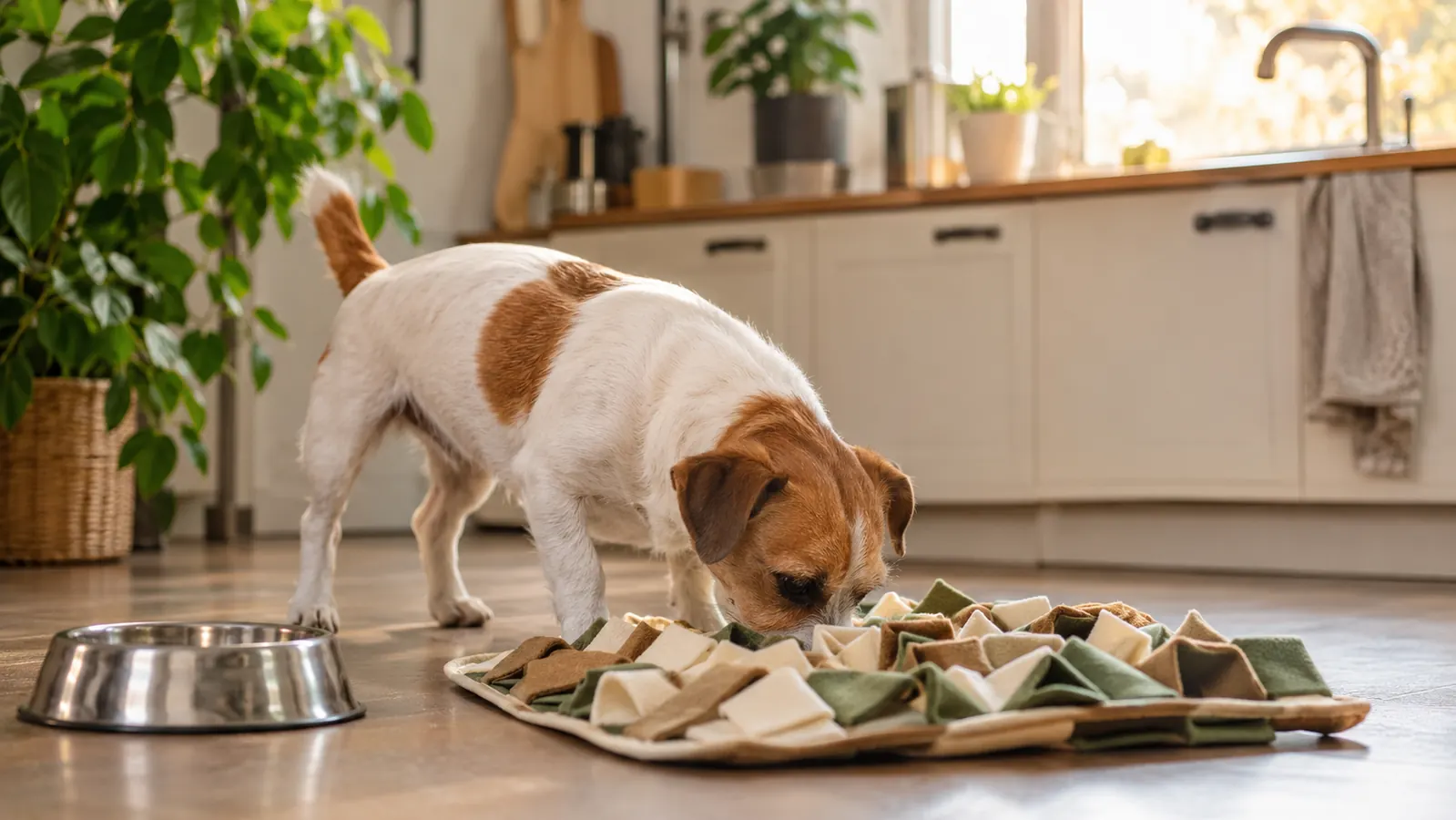
The first Tuesday in February, I put the AWOOF snuffle mat down on my kitchen floor, scattered Pip's breakfast kibble through the felt, pulled my coat on, and stood in the doorway to watch. He sniffed one corner, sneezed, and walked back to the donut bed in the living room and lay down with his back to me. I drove to my volunteer shift at the library convinced I had bought one more thing for the hall closet.
That was nine months ago. This morning, a Thursday, he finished his breakfast out of the same mat in about ten minutes, then sat by the cupboard door near the back door where I keep it, which is his way of asking for a second round I never give him. I adopted Pip, a terrier-Chihuahua mix, from a county shelter in the second week of December. He is about four years old and weighs thirteen pounds. He came to me scared of loud noises and scared of being left alone, and the alone part is what sent me looking for a snuffle mat in the first place.
The Quick Verdict
Nine months, two mornings a week, and it still buys me a quiet kitchen for the ten minutes he works it. It did not cure anything. It gave him a job on the mornings I walk out the door.
Amazon Check Today's Price →The Ten Minutes That Make My Tuesday Mornings Easier
Breakfast as a job instead of a bowl. Same mat, nine months of twice-weekly use, still the first thing he checks when I reach for the cupboard.
Amazon Check Today's Price on Amazon →How I've Used It
I went back to my Tuesday and Thursday morning shifts at the Plymouth library in February, which means Pip is alone for about three hours on those two mornings. Three hours is not a long time. It is long enough for a dog who does not like being left to spend the first twenty minutes pacing the hall and the next twenty standing at the window. I wanted something that would take him a little while and end with him fed, so his breakfast became the job.
The routine has not changed since the first week. I keep the mat on the shelf in the cupboard by the back door. On Tuesday and Thursday I open it out on the kitchen floor, scatter his kibble through the felt, and let him at it while I finish my coffee. Then it goes back in the cupboard and I go out the door. He does not get it any other morning, not because there is a rule against it but because the two mornings he is alone are the two mornings it earns its keep, and I do not want it to turn into wallpaper.
Before the mat, I left him a chew toy on those mornings. It sat exactly where I put it, every single time, and I would come home and pick it up off the same spot on the rug. That is the honest reason I kept going with the snuffle mat after a bad first week. One of them got used and the other one did not.
The mat is 18.8 inches across and weighs under five ounces. Pip is thirteen pounds, so that is more mat than dog, and the listing recommends it for large breeds, which made me hesitate at first. What I found is that a big mat is easier for a small dog, because he can work the near half and never has to step over his own feet to get to the far side. He circles it once, then settles with his front paws on the edge and his nose down. The bottom is a non-slip cloth and on my kitchen linoleum it stays put; he pushes it maybe an inch over a whole session, no more.
What You Actually Get
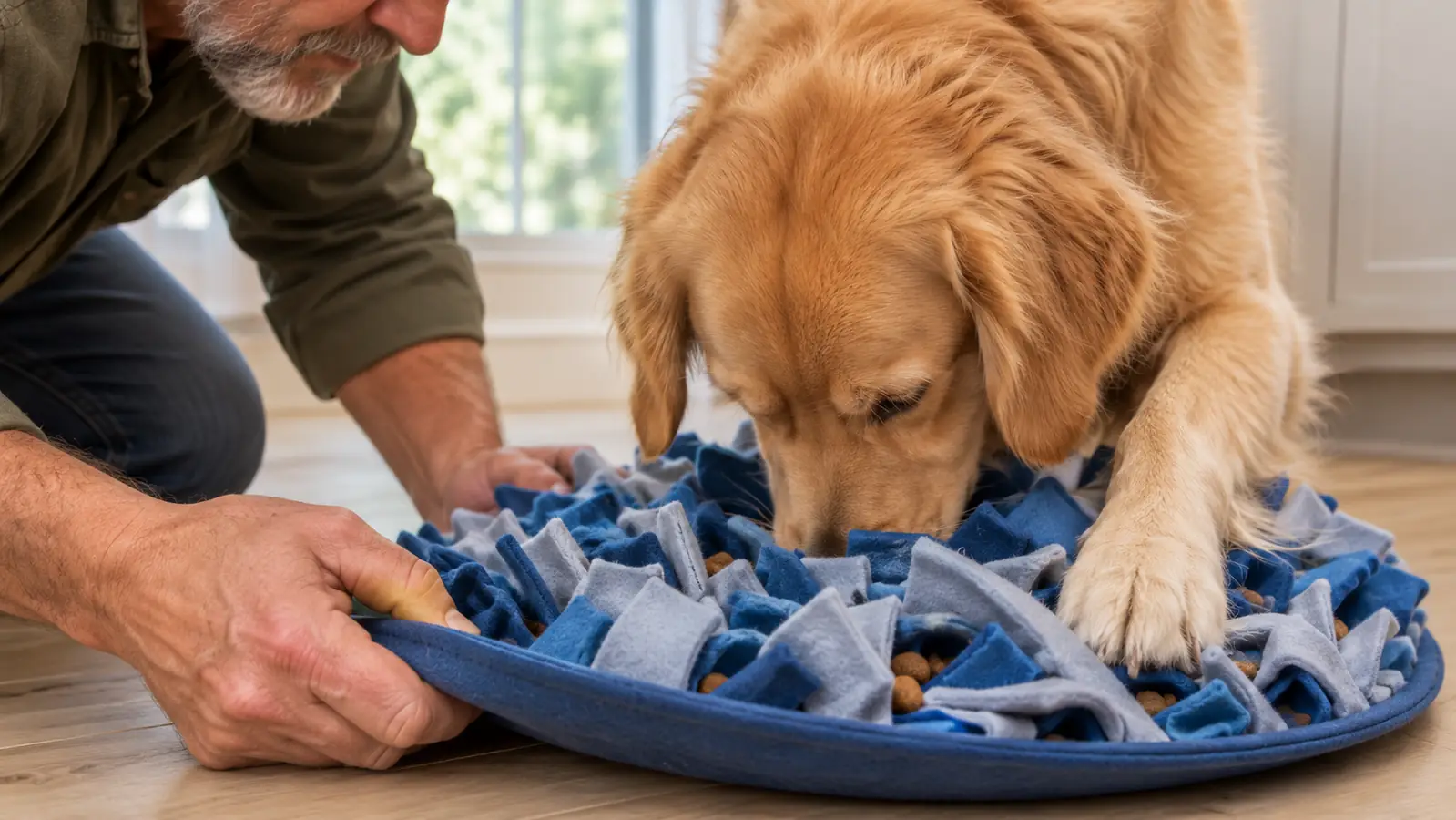
The AWOOF mat arrives as one piece, a flat pad of felt cloth with a non-slip cloth backing, and it is light enough to pick up with two fingers. The felt is the part that matters. You push kibble down into the fabric and the cloth folds back over the food, so the dog has to work his nose into it rather than spotting a pile and hoovering it up in one pass. The listing calls it a scent pad, and that is closer to the truth than calling it a bowl.
How much food it holds depends on how hard you press. I scatter about a third of a cup, which is most of Pip's breakfast, and it disappears down into the felt with room to spare. On a morning when I have pushed it in deep, he surfaces pieces twenty minutes later that he missed on the first pass, which is either charming or a sign that I am not very good at hiding food.
It also folds into itself into a bowl shape, which the listing calls a dual-use design. I have folded it into the bowl twice, both times out of curiosity, and it does work, but I do not use it that way. I do not call it a travel mat either, even though the listing does. Mine lives on a cupboard shelf and goes on a kitchen floor, and that is the whole of its career so far.
One thing to know before you buy: the mat is not water resistant. Felt holds moisture, so a mat that comes in wet or gets hosed off outdoors is going to sit damp and start to smell like a gym bag. This is an indoor mat for dry kibble or dry treats. I would not leave it out on a porch or in the yard.
The First Week Was Not Encouraging
The first morning was a failure in the mildest possible way. I scattered the kibble, set the mat down, and Pip gave it about forty-five seconds. He got two pieces out, decided the effort was not worth the reward, and walked away. I stood there in my coat feeling foolish. The second morning was the same, and the third. By the end of that week I had decided it was a dud and was ready to put it in the closet next to the flat foam bed he had ignored in December.
What I did instead, on the second Tuesday, was make the job easier. I scattered the kibble less deeply, just pressed into the top layer of felt, and I sat down on the floor beside the mat while he worked. That is the entire adjustment. It was not a training method, it was me cutting the job down to a size he could finish. That Thursday he cleared the shallow version in about four minutes and then looked up at me for more, which I had not seen him do with any toy since he came home.
What Changed in the Second Week
By the second week I was pressing the kibble deeper and he was digging it out. By the end of February he was working the mat for about ten minutes, and nine months later that is still where it sits, which surprises me. I expected a smart dog to get bored of a piece of felt. He has not, and I think the reason is that there is no pattern to learn. The kibble lands somewhere different every morning, so it is a fresh search each time instead of a puzzle he has already solved.
The change I did not expect was what he does afterward. On a morning he works for his breakfast, he goes to the donut bed and sleeps. On a morning I just set the bowl down, he is up and down the hall for the first half hour. I am not going to tell you a mat calms a dog's anxiety. A piece of cloth cannot do that and I would be lying to you if I said otherwise. What I will tell you is that ten minutes of using his nose for the thing he wanted leaves him in a different place than ninety seconds of swallowing breakfast off a linoleum floor. If your dog is genuinely panicked when you leave, call your vet, because this is not medicine and it is not a treatment plan.
It did not fix his anxiety. What it did was give him ten minutes of work before I walked out the door, and the dog who has worked is easier to leave than the dog who has only eaten.
Cleaning, Folding, and What I Don't Love
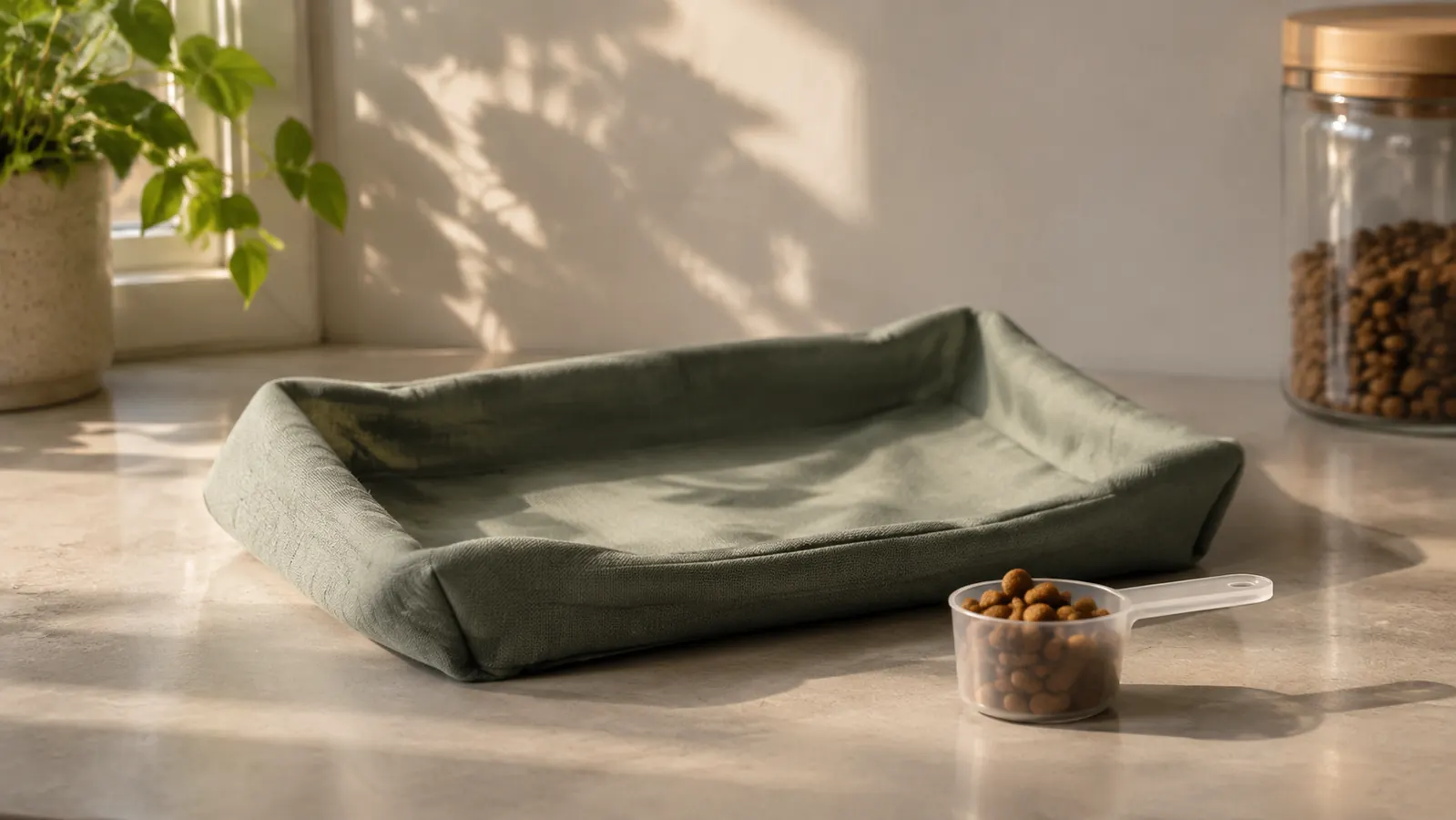
I have never put this mat in a washing machine and I do not intend to start. Felt and a non-slip backing are not built for a spin cycle, and nine months in I am not interested in finding out what a dryer does to it. My routine is a shake-out over the sink, a hand rinse under cool water, a squeeze, and about a day of air drying flat on the counter. It comes back looking the same. The AWOOF mat has not frayed in nine months of twice-weekly use, though the felt has gone a little soft where he works it hardest, which I take as ordinary wear.
My complaint is crumb dust. Kibble leaves a residue down in the bottom of the felt, and after three or four uses the mat starts to smell faintly like the inside of a kibble bag. The hand rinse handles it, but it means the mat is out of action for about a day, so I time the wash for a Wednesday or a Friday. If you have a dog who eats twice a day and you want to use this thing daily, you will want either a second mat or a tolerance for a kitchen that smells like dog food.
What I Liked
- The felt holds kibble well enough that a thirteen-pound dog takes ten minutes over breakfast instead of ninety seconds
- The non-slip cloth backing stays put on kitchen linoleum, moving about an inch over a whole session
- At 18.8 inches across there is room for a small dog to work one half without stepping on his own feet
- Shakes out and hand-rinses clean, and nine months of twice-weekly use has not frayed it
- Folds flat onto a cupboard shelf, so it is out of the way on the five mornings I do not use it
Where It Falls Short
- The first week took a deliberate adjustment, shallower kibble and me sitting on the floor, before Pip would work it
- The felt is not water resistant, so it is strictly an indoor dry-food mat and it holds a kibble smell between washes
- It needs about a day to air dry, which takes it out of action unless you own two
- The large-breed recommendation on the listing will put off small-dog owners who would actually get on fine with it
- It is not a substitute for a walk, and it is not a substitute for real help with separation anxiety
How It Compares to the Lick Mat I Also Own
I bought a lick mat in the spring, mostly because every rescue group on the internet talks about them, and I use it on weekend mornings with a spoon of plain yogurt. Pip finishes it in about five minutes. That is not a knock on the lick mat, it is a different job. A lick mat is fast, it is quiet, and it is something to do while you are in the room. The snuffle mat is slower and it is closer to work.
If you are choosing between the two, ask what you want the ten minutes for. If you want a dog occupied while you eat your own dinner, a lick mat does that and rinses in thirty seconds. If you want a dog tired before you leave the house, the snuffle mat does it better, because sniffing is harder work than licking. I keep both. If I had to give one up I would keep the snuffle mat, because it is the one that gets used on the mornings that actually matter.
Who This Is For
This is for the person leaving a dog alone for a few hours who wants those hours to start with something other than a bowl and a closed door. It suits a dog who eats too fast, a dog who needs a job, and a dog whose nose is the smartest part of him. It suits a small dog fine, the large-breed recommendation on the listing notwithstanding, and the listing says cats too, though I have no cat and cannot tell you one way or the other. It suits anyone who wants a feeding routine that costs thirty seconds of setup and one hand rinse a week.
Who Should Skip It
Skip it if your dog is a shredder. Pip has never chewed anything he was not handed, so I cannot tell you what this mat looks like after a determined chewer has forty unsupervised minutes with it, and felt is not going to survive that. Skip it if you need something for the yard, because it is not water resistant and it will sit damp. Skip it if you are hoping it will solve separation anxiety on its own. It will not. It is a better breakfast, not a treatment, and a dog who is genuinely panicking when you leave needs a vet and a plan, not a mat. What it did for us was make the leaving easier at both ends of the door, and nine months in, that has held up better than I expected.
Nine Months In, Still the First Thing He Checks
If your mornings start with a dog and a closing door, this is the best ten minutes of quiet I have found. Same mat I bought in February, still in the cupboard by the back door.
Amazon Check Today's Price on Amazon →