
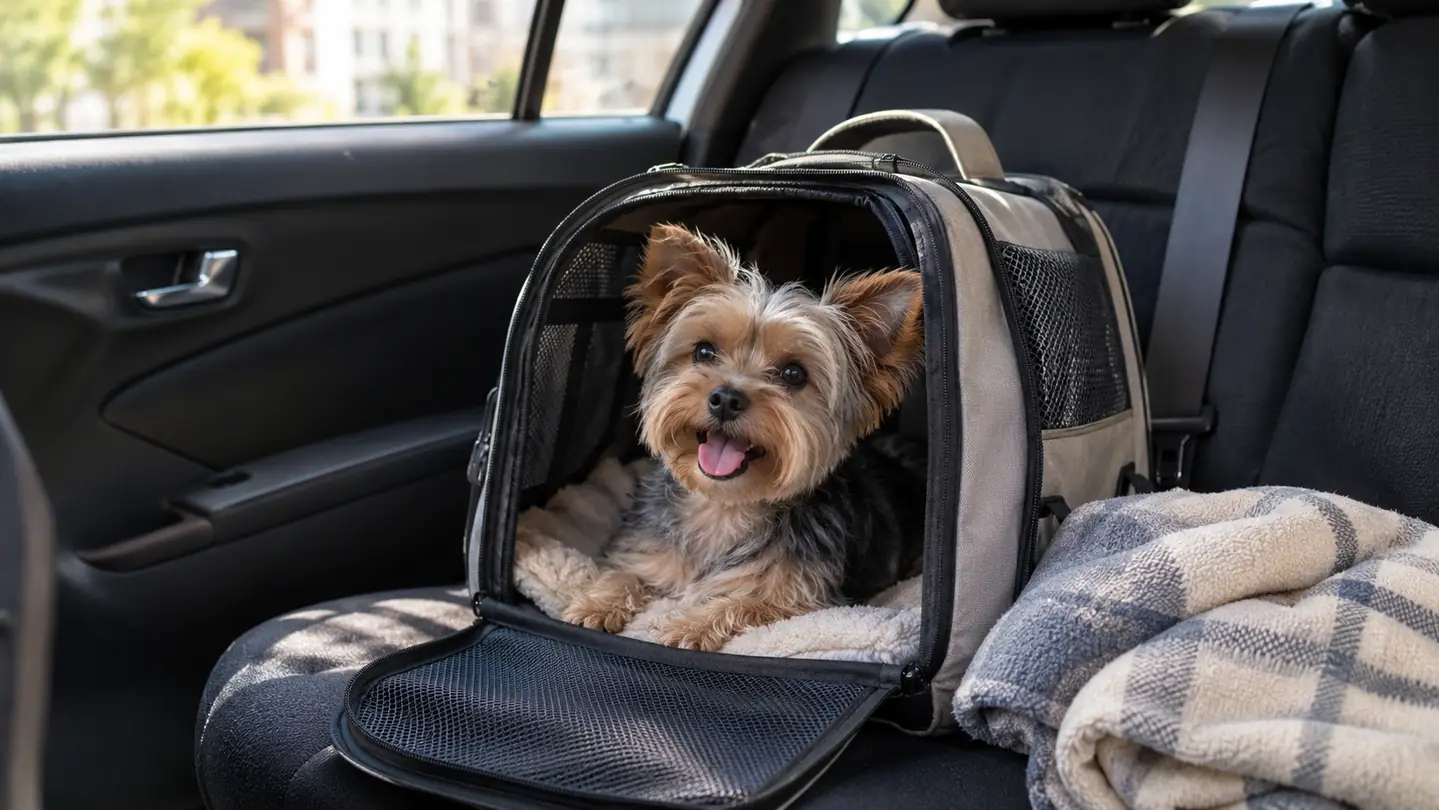
The first carrier Pip ever rode in was not mine. It was a hard plastic crate I borrowed from Marge down the street, and it rattled the whole twelve minutes to Dr. Amaral's office in the last week of December. Pip is thirteen pounds, a terrier and Chihuahua mix I adopted from the county shelter three weeks before that visit, and he shook the entire way. Not a tremble. A shake, the kind you can feel through the plastic when you rest your hand on the lid. I sat in the parking lot afterward with the engine off and thought: he is going to have to do this again, a few times a year, for the rest of his life. I have to find a better way to get him there.
That is how the Henkelion soft carrier ended up in my house in January, a few weeks before his second visit. I am not a trainer and I am not a vet. I spent thirty years working in a school office and retired, and I live in Plymouth, Massachusetts with one small dog who came to me scared of loud noises and scared of being left alone. I bought this thing the way most people buy things. I read a lot of listings, guessed, and hoped. What follows is eleven months of ordinary use: three vet trips and one very patient two-week campaign involving a lot of tiny treats on the kitchen floor.
The Quick Verdict
The carrier that got Pip to the vet without the shaking. Light, folds flat on a closet shelf between trips, and easy to leave open on the floor while a nervous dog decides it is not a trap. Not crash tested, and not for a dog who chews.
Amazon Check Today's Price →The carrier that ended the shaking on the way to the vet
Seventeen inches long on the outside, rated to fifteen pounds, and it collapses flat enough to live on a closet shelf between appointments. Pip is thirteen pounds and has room to turn around and lie down.
Amazon Check Today's Price on Amazon →How I've Used It
The Henkelion arrived in January, before his second vet visit, and it has been to Dr. Amaral's office three times since: January, April, and September. That makes four vet trips total for Pip, one in Marge's borrowed crate and three in this one. Between trips it lives on a closet shelf, folded, because it collapses down flat enough to slide in behind the vacuum cleaner. I have never left it sitting in the car. That was deliberate. I wanted the carrier to mean the vet and nothing else, so it goes back on the shelf the moment we walk in the door and the treats come out on the kitchen floor instead.
The fold is the part I did not expect to care about. It folds down flat, which is how it goes on the closet shelf. In a one-story house with no closets to spare, that matters more than any feature on the listing. It goes on the top shelf of my front closet, and I do not see it again until the next appointment. The first time I pressed it down I was sure I had broken something. I had not. It came back up into the same shape in April and it has not failed to since.
The carrier has not been anywhere except the vet. Not road trips. I am not a road trip person and neither is he. Three visits, four miles each way in the back seat, and he has been fine on every one of them. That sounds like nothing to anyone who has a dog that hops in the truck. For a dog who shook through a plastic crate in December, it is not nothing.
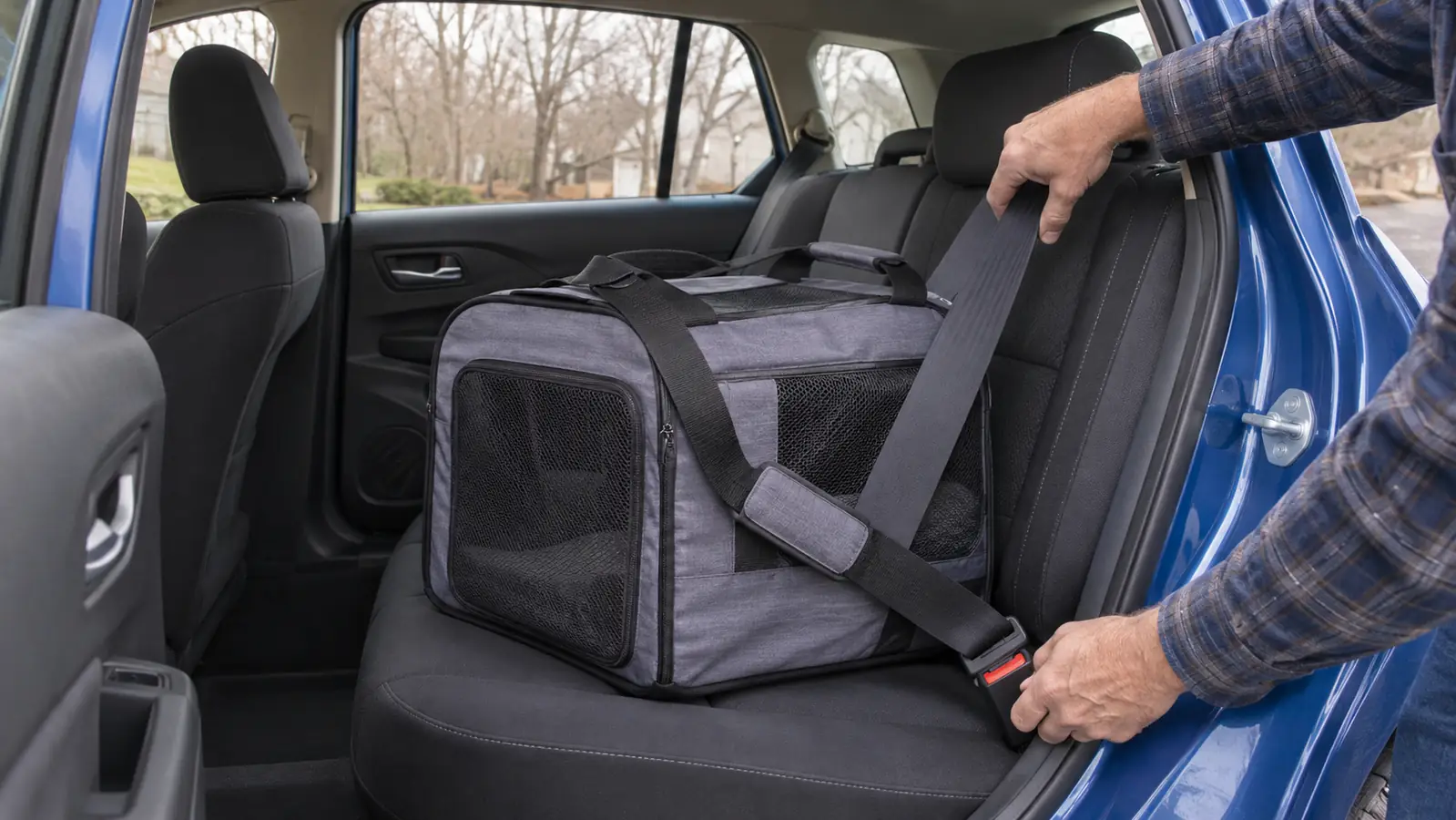
How it rides in the car: the carrier sits on the back seat and I run the car's seat belt through the carry handle. That is the whole system. It is not a crash tested car seat and I am not going to sit here and tell you it is. What it does is keep him off my lap and away from the pedals, which was the actual problem I was trying to solve on Route 3A in December.
What Two Weeks of Treats Actually Looked Like
I spent two weeks before the first ride getting him used to the thing, because December had already taught me that a scared dog in a carrier is a miserable twelve minutes for everybody involved. Days one through three he would not put his head inside. Not once. I set the carrier on the kitchen floor with the zipper open and dropped a treat just inside the opening, and he took the treat off the floor next to it and backed away like the carrier might follow him.
Day four his head went in. That was all. Head in, head out, treat. Day six he was standing in it with all four feet, which surprised me more than it should have, and I sat down on the floor next to him for a while after that because I did not want to spook him by getting excited. Day fourteen he was lying down in it on the kitchen floor while I made coffee two feet away.
Days seven through ten are the stretch I would tell anyone to plan for, because that is when it stopped being a game and started being a thing he had to do. On day eight he went in, took the treat, came straight back out, sat down, and looked at me. I did not push it. I put one more treat in, he went back in, and we stopped there for the day. Two steps forward and one back, twice over, and then he was fine with it. If your dog does that, it is not failing. It is just how it goes with a dog who has already decided the world is a place where things happen to him.
The point of that story is not that I trained my dog, because I did not do anything clever. The point is that the carrier did not fight me while I did it. The closure is a zipper, so I could open it up and leave it open on the floor for two weeks without it folding in on him. It sits flat on the floor when a nervous dog steps on the edge. The sides are soft fabric, so when he leaned against them there was nothing to clonk his head on. Marge's hard crate could not do any of that, which is exactly why it went back to her garage after one week in my front hall.
By day fourteen he was lying down in it on the kitchen floor while I made coffee. That is most of the review, honestly.
The Sizing Question, and Why I Measured First
I measured Pip with the tape from the kitchen drawer before I ordered anything in January. Chest seventeen inches, neck eleven. He weighed thirteen pounds at the shelter and he has held right around there for eleven months, which is the only reason I felt comfortable with a carrier rated to fifteen.
The listing gives the outside as seventeen inches long, eleven wide, and eleven high, and says the inside is meant for a pet within fifteen by nine by nine. That gap between outside and inside matters more than it sounds like it does. It is the difference between a dog who can stand up and turn around and a dog who is folded in like a sweater in a drawer. Pip at thirteen pounds has room to turn and lie down. Two more pounds of dog and I think it would be tight, and I would be looking at the next size up rather than talking myself into this one.
I also want to say something about that fifteen-pound number, because a rating is not a promise. Pip is thirteen and he fills maybe two-thirds of the floor space when he lies down, and he is short-legged, which is most of the reason he fits. A fourteen-pound dog with long legs would be a different story in this same carrier. Weigh your dog on a real scale at the vet's office rather than lifting him and guessing, then subtract a pound or two for good measure.
The carrier itself is listed at 2.2 pounds. I have carried it one-handed from the car to the vet's front door with a thirteen-pound dog inside and my purse on the other shoulder, and I did not have to set it down in the parking lot to switch hands. If your dog is bigger, or your walk from the lot is longer than mine, that number is the one worth staring at before you click anything.
Three Vet Trips Later: What Held Up and What Did Not
Three trips in nine months is not heavy use, and I am not going to describe it as though it were. Here is what I actually know. The zipper has not caught, split, or chewed a tooth. The stitching where the shoulder strap meets the body of the carrier has not pulled. The shoulder strap is still padded. The floor of it has not sagged, even after a dog spent twelve minutes shifting his weight around and scrabbling once when a motorcycle went past outside the exam room window.
The April trip is the one I remember, because the waiting room was full and we sat for twenty-five minutes. Pip was in the carrier on my lap with it zipped and I could work my hand in through the zipper and rest it flat on his back. That is the other thing soft sides buy you. He could feel my hand the whole wait. In Marge's hard crate in December he could not, and he spent that entire visit with his nose jammed up against a plastic grate, and I spent it apologizing to a dog.
What I do not know is how it holds up to a dog who chews. Pip has never chewed anything, not a shoe, not a cord, not the fleece blanket he slept under for his first two weeks here. The sides of this carrier are soft fabric. I would not leave a dog alone with it who likes to work at seams and zippers, and I would not use it as a crate. That is not a knock on the carrier. It is a knock on expecting soft fabric to do a hard crate's job.
One small thing I noticed: by the September trip the carrier had a slight lean to it, and I realized I had been storing it with the shoulder strap wrapped around it, which had pressed a curve into one side. It flattened back out in a day once I stopped doing that. Not a defect. Just what happens with soft-sided anything that gets stored folded.

The Airline Label I Have Not Tested
The listing says airline approved and the title mentions TSA, and I want to be very plain with you about my qualifications on that point, which are none. I have never flown with Pip. I have not been on a plane in years and I would not book a flight on the strength of a word in a product title. So I can tell you what the listing claims and I can tell you the outside measurements I took with my own tape, and that is the end of what I know.
If flying is the reason you are reading this, call the airline before you buy. Not the website, the number. Ask what dimensions they allow for a pet in the cabin and measure this carrier against that number, not against a review from a woman in Massachusetts who drives a hatchback. Mine measured seventeen by eleven by eleven on the outside. Your airline's number decides, not mine, and it can change between the day you book and the day you fly.
What I Liked
- Light enough to carry one-handed with a thirteen-pound dog inside
- Collapses flat and stores on a closet shelf between trips
- Soft sides give a nervous dog something to lean against instead of a hard wall
- Zip closure means it can sit open on the kitchen floor for treat training
- Rated to fifteen pounds, and a thirteen-pound dog had room to turn and lie down
- Padded shoulder strap plus carry handles leaves a hand free for the car door
Where It Falls Short
- Not crash tested, and I would not call it a car seat
- Soft fabric is the wrong choice for a dog who chews at seams
- The airline approval is the listing's claim, not something I have tested
- Thirteen pounds felt close to the practical top for a dog who wants to stand
- Nothing inside it is rigid, so it does not shield a dog from a hard knock
Who This Is For
This is for the person with a small dog who has started to dread the drive to the vet. Under fifteen pounds, ideally closer to thirteen, and a dog who will accept being handled and fed treats on a kitchen floor for two weeks. It suits someone who wants one thing that does the vet, the occasional car ride, and then disappears onto a shelf instead of squatting in the hall taking up space. It suits a dog who is nervous rather than destructive. If that is your house, the Henkelion is the version of this I would buy again, and I would spend the two weeks on the floor first, because that is where the change actually happened for Pip.
Who Should Skip It
Skip it if your dog chews, if your dog is over fifteen pounds, or if what you want is real restraint in a crash. A soft-sided carrier is not that and no amount of wishing makes it that. Skip it if your dog panics at being enclosed and you have not tried desensitizing first, because a zipped bag does not calm a frightened animal, it just contains one. Skip it if you are flying next month and have not called the airline. And skip it if your vet has told you your dog's anxiety needs more than a quiet car ride, because that is a conversation for Dr. Amaral and not for a product listing. I am only telling you what happened with my dog.
If your dog shakes the whole way to the vet, start with the treats and this carrier
Two weeks of treats in an open carrier on the kitchen floor did more for Pip than any amount of hurrying. He is thirteen pounds, and he rides in the back seat with the belt through the handle.
Amazon Check Today's Price on Amazon →