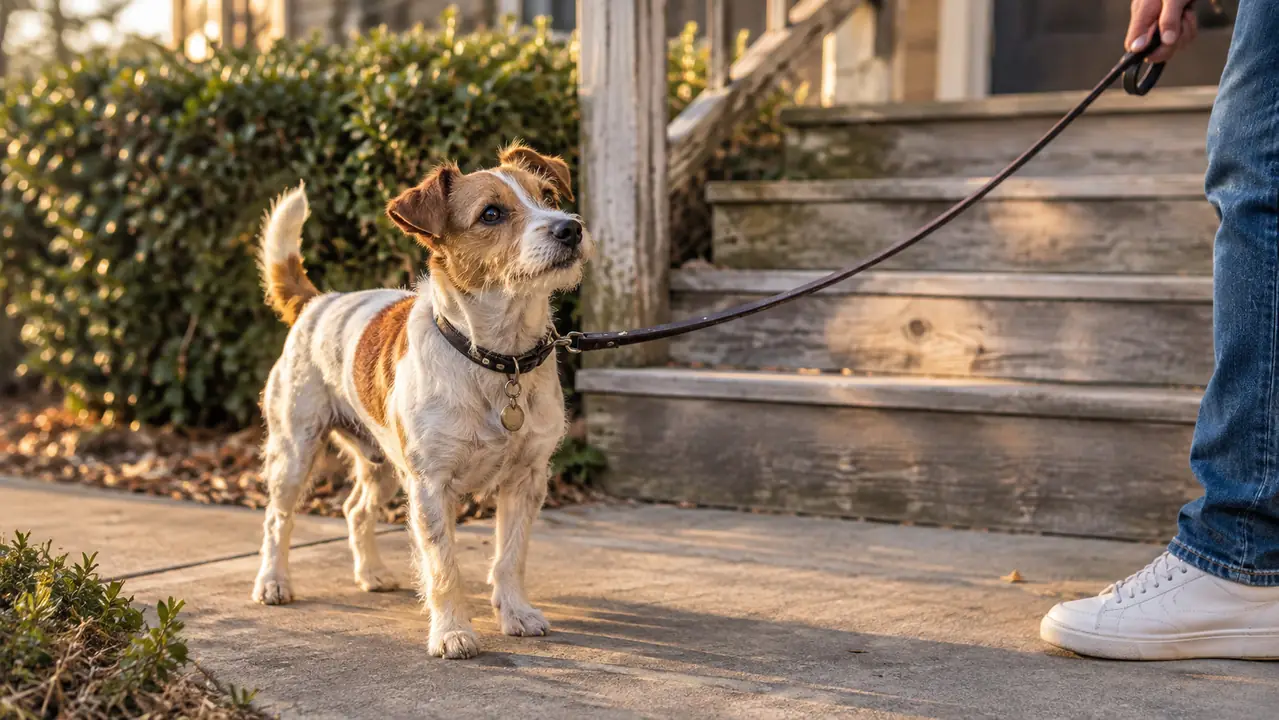
Pip came home from the county shelter in the second week of December. He was a four-year-old terrier and Chihuahua mix, thirteen pounds, and for the first nine days he wore a flat nylon collar from the pet aisle. Then a trash truck banged at the curb while we were at the back steps. He backed straight out of that collar and ran two houses down. It took ten minutes, a slice of cheese, and Marge's hedge to get him back. He was not hurt. I ordered the Gooby Escape Free Easy Fit harness and the AirTag collar that night around eleven. He has never slipped the harness in the ten and a half months since.
I am not a trainer. I spent thirty years in a school office and retired, and now I live alone in Plymouth, Massachusetts with one dog. Before Pip, I had only ever had family dogs, the kind who stayed in the yard and came when you called. A rescue dog who was scared of loud noises was a different job. For the first few weeks I read every label in the pet aisle and second-guessed all of it. What I can offer is not theory. It is what happened with my dog, on our two walks a day, in rain and cold and one very loud July 4th.
The Quick Verdict
The Gooby Escape Free Easy Fit has kept a thirteen-pound dog who once backed out of a collar attached on every walk for ten and a half months. It did not train him out of startling. It made the walks safe enough to keep going.
Amazon Check Today's Price →The Harness I Ordered at 11 p.m. After He Backed Out of His Collar
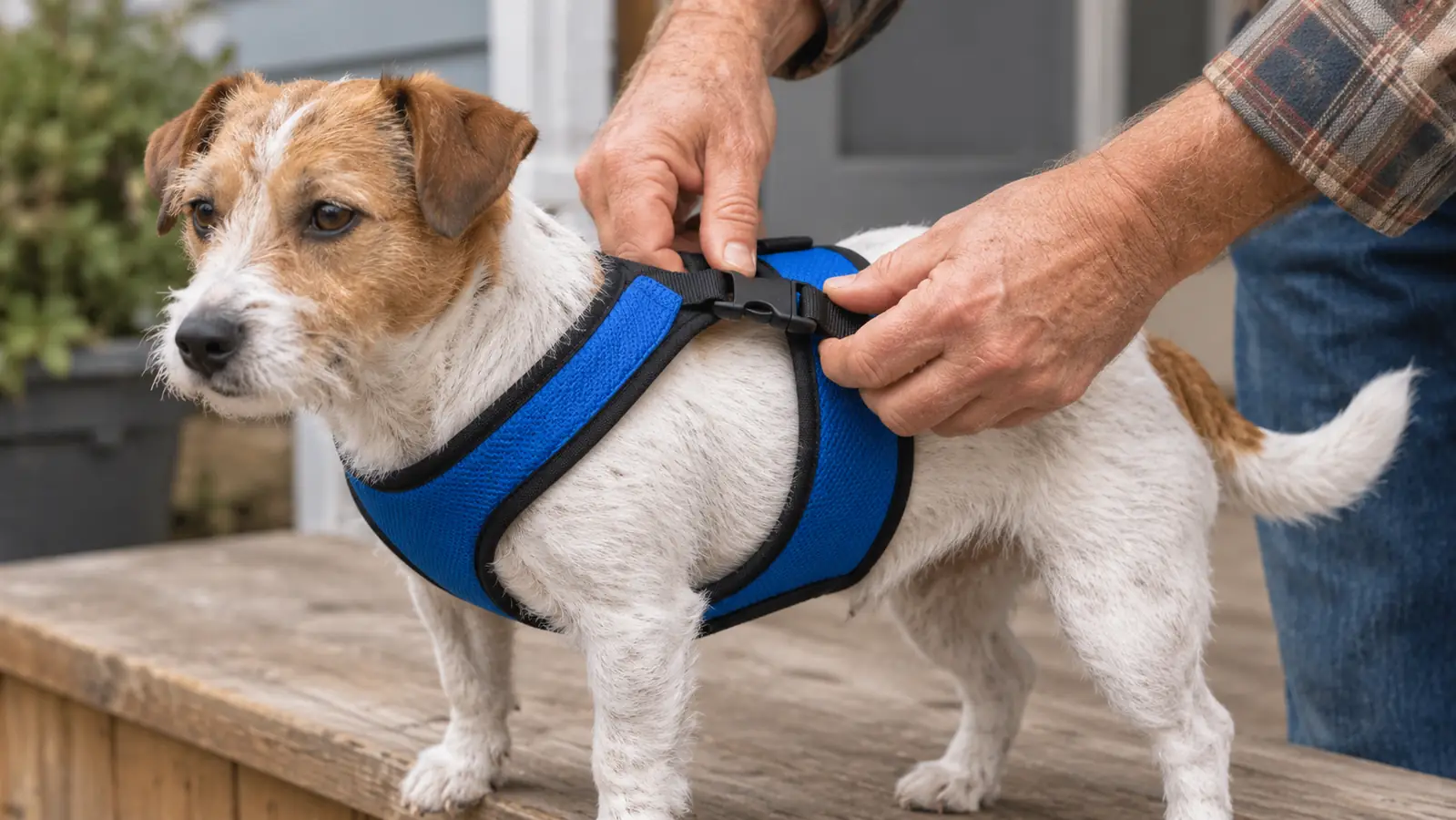
The Gooby Escape Free Easy Fit is a step-in harness with a buckle closure and a design that reduces space around the back. That last part is why I bought it. Pip steps in, I fasten the buckle, and the leash clips to the harness, never to his collar.
Amazon See the Gooby Harness on Amazon →How I've Used It
I measured Pip with the tape from the kitchen drawer before I ordered. Chest seventeen inches, neck eleven inches. The Small size is listed for a chest of 16 to 19.25 inches, so that was the size I chose. When the box came, the harness weighed almost nothing in my hand, 2.24 ounces on the listing. The frame is lightweight and the leash ring is a POM plastic ring. I checked the ring with my thumb before I ever clipped a leash to it, because that is the part that has to hold.
The harness hangs on a hook by the back door. He wears it for walks and only for walks. In the house he wears the AirTag collar with his license and ID tag. On the walk, the leash clips to the harness. That is not a small rule in our house. The night he backed out of the flat collar is the reason the rule exists. He has never slipped this harness, not once, not even on the morning a school bus let out its air brake two driveways over.
The first few weeks were not graceful. I would hold the harness open on the floor, and Pip would put one paw in and then freeze. He did not fight me. He just stopped, the way a scared dog stops when he is not sure what happens next. I did not rush him. I put a treat on the floor near the harness, then inside the opening. By the second week he was stepping in on his own. The buckle closure takes me a few seconds. The step-in design is the reason I could keep the thing low and calm on the floor instead of lifting it over him.
I will say the honest thing here. There were mornings in January when I stood in the doorway with the harness in my hand and thought, he is never going to like this. He did not like it. He tolerated it, and then one day he walked into it before I had finished putting my coat on, and that was that. Ten and a half months later it is simply part of the leaving-the-house order of operations. Coat, keys, harness, leash, out the door.
Why the Step-In Design Mattered for Pip
Gooby describes the Easy Fit as reducing space around the back. That is the feature I would point to first. On a dog who has already shown he will back out of something, a loose gap above the shoulders is an invitation. The harness we have sits close around Pip's back and behind his front legs. I am not saying it works for every dog. I am saying that on my dog, the shape of it gave him less room to shrink and twist.
The step-in part matters just as much. I set the harness on the floor, he steps in with both front paws, and I fasten the buckle. There is no moment where I am pushing his head through a loop. For a dog who came to me scared of loud noises and sudden moves, that quiet routine is worth more than any feature on a box. By March, about three months in, he had mostly stopped lunging at noises on our walks. I do not credit the harness with changing his feelings. I credit it with keeping him attached while we practiced.
The leash ring is the one piece I watch. It is POM plastic, not metal. I have friends who will only use metal, and I understand that. All I can report is what happened with ours. Two walks a day for ten and a half months, one thirteen-pound dog, and the ring has not worn through or bent. The harness is listed at 2.24 ounces, so it does not weigh him down. When I pick him up to carry him over a patch of ice, the harness is not the heavy thing in my arms.
The Back Space and the Buckle
The back space is the part that made me choose this harness over a plainer step-in. A dog who bolts does not need a harness that hangs off him. He needs one that stays where it is put. Gooby says the design reduces space around the back. On Pip, that means the straps sit close and the body of the harness does not slide up toward his neck when he pulls. I still check the fit before every walk. I put two fingers under the chest strap, and if I can slide them easily, we are fine.
The buckle closure is simple, which I like at seven in the morning. The buckle fastens, and I check it with my hand before we step out. I do not have to wrestle with it in the dark. The Small size is listed for a chest of 16 to 19.25 inches and up to 35 pounds. Pip is thirteen pounds, so he is well inside the weight range, and his seventeen-inch chest sits in the middle of the size. That is the kind of thing you should check before you order. A harness that is too big around the chest is not an escape-free harness. It is a loose harness with a hopeful label.
One thing I did not expect: the harness made it easier for me to read him. When a dog wears a collar and pulls, you see the collar tighten and you cannot always tell what he is about to do. With the harness, I could see his shoulders. If his shoulders went low and his weight shifted back, I knew a noise had caught him before he tried to turn. That half second was enough for me to shorten the leash and keep walking. I am not a trainer and I am not claiming a harness teaches you to read a dog. I am saying it gave me something to watch that a collar did not.
What Ten and a Half Months of Walks Looked Like
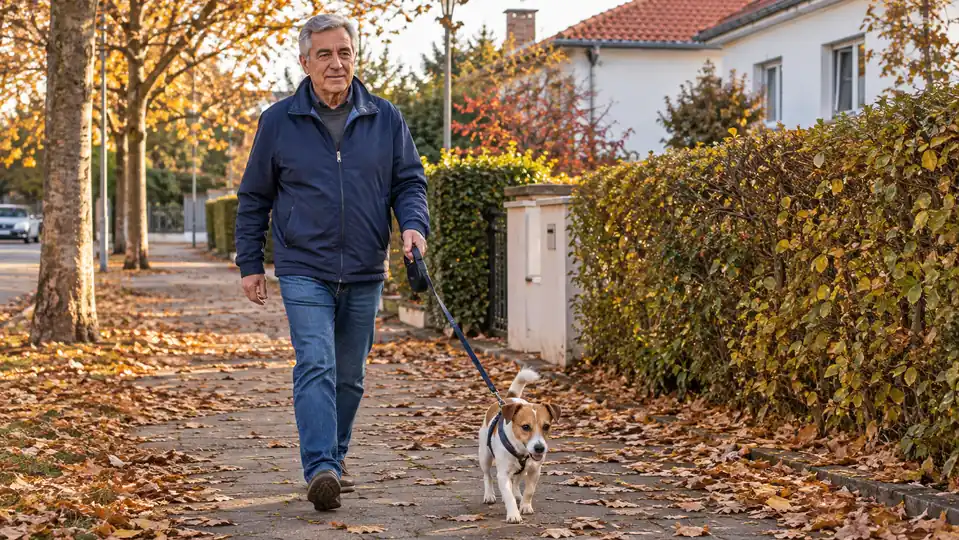
We walk twice a day, usually the same loop around the neighborhood. In December and January, Pip walked with his tail low and his ears back. If a truck downshifted, he would try to turn toward home. I kept the leash short but not tight, and I kept it on the harness. The harness did not make him brave. It made it possible for me to keep him close while he learned that the truck would pass and we would keep going.
By March, the change was obvious enough that Marge commented on it. He still does not like the trash truck. But he stopped lunging at every noise, and he started walking past the hedge where he hid that first week without trying to pull toward it. I know that sounds small. When you have a dog who once slipped a collar, small is the whole goal. The harness was the constant. The walks were the work.
On July 4th, the harness stayed on its hook. Pip spent the evening in his donut bed in the bathroom with the radio on and me on the floor beside him. He was shaky, but he stayed in the bed. I did not put the harness on him for comfort, because the harness is for walks. That is the routine in our house. The collar carries his tags, the harness carries the leash, and the bed is where he goes when the world gets loud.
During the winter, the harness got wet on almost every walk. I hung it on the hook and it dried by the door. The POM ring never froze to the leash. The buckle still opened and closed. I do not have a garage, so the hook by the back door is the only spot where the leash lives. Seeing the harness there became part of the routine, the same way the leash by the door did.
Cleaning, Storage, and the Small Details
The harness is machine washable. Gooby says cold water and hang dry, and that is what I have done. I take it off the hook, wash it in a mesh bag on a cold cycle, and hang it over the shower rod to dry. It has held up. I do not wash it every week, because Pip is not a dog who rolls in things. When it gets salty from winter sidewalks, it gets washed. The rest of the time it hangs by the back door, ready for the next walk.
The size is the part I would tell a friend to slow down on. The Small is built for a chest of 16 to 19.25 inches. It is not the right harness for a dog whose chest is outside that range, no matter how small the dog looks. Pip measured seventeen inches. I wrote it on the back of an envelope and took it to the computer with me. That envelope is still in the kitchen drawer. If you are ordering for a dog who backs out of collars, measure the chest first, then order the size that matches the number.
Gooby lists a one-year manufacturer warranty when the harness is purchased from Gooby or an authorized dealer. I have not had to use it. I am mentioning it because it is part of what you are buying, and because a leash ring and buckle are the two parts that take the daily wear. If either one starts to look worn, I would stop using the harness and contact the seller. That is not a dramatic warning. It is what I would do with any piece of gear that holds my dog.
What I Liked
- Step-in design let Pip walk into the harness on the floor instead of having it lifted over him
- The design reduces space around the back, which gave my dog less room to shrink and twist
- Lightweight at 2.24 ounces, even for a thirteen-pound dog
- POM plastic leash ring has held through two walks a day for ten and a half months
- Machine washable, cold, hang dry
- Small size fits chest 16 to 19.25 inches and dogs up to 35 pounds
Where It Falls Short
- First few weeks Pip froze when I put it on. A scared dog may need treats and time
- If your dog's chest is outside 16 to 19.25 inches, this size is wrong
- The leash ring is plastic. Some owners will want metal
- It does not teach a dog to stop lunging. It keeps him attached while you work on that
- This exact size is not the one for a dog over 35 pounds
Ten and a half months. Two walks a day. He has never backed out of the Gooby harness.
Who This Is For
This harness is for the person with a small dog who has backed out of a collar, or who looks like he could. It is for a dog whose chest measures between 16 and 19.25 inches and who weighs up to 35 pounds. It is for someone who walks the same loop twice a day and wants the leash attached to something that stays on. It is also for the owner who is willing to spend the first week going slow, with treats and a calm floor and no tugging.
People ask me if I still check the fit. I do. Before every walk I put two fingers under the chest strap and I press the buckle with my palm. It takes about five seconds. I have done it so many times that Pip now stands still for it without being asked, which is its own kind of progress for a dog who used to freeze.
If you are in week one with a rescue and you are standing in the pet aisle trying not to cry, I understand. I was there. I do not think a harness fixes a scared dog. I think it gives you a way to keep him safe while the rest of the work happens. That is what the Gooby did for us.
Who Should Skip It
Skip this exact size if your dog's chest is outside 16 to 19.25 inches. Skip it if your dog is over 35 pounds. A harness that does not fit is not a bargain and it is not a safety net. It is just a loose piece of gear. Measure before you order, and if the number falls between sizes, ask the seller which size to take.
Skip it if you want a harness to stop pulling. This is not a training plan. Pip stopped lunging because we walked the same loop twice a day for months and I kept him close when he got scared. The harness kept him attached. It did not do the teaching. If your dog has serious anxiety, or has bitten or injured himself trying to get out of gear, talk to your vet about a behavior plan. A harness is a tool, not a treatment.
If Your Dog Is One Loud Noise Away From a Slip, Start With the Fit
I cannot promise your dog will never startle. I can tell you the Gooby Escape Free Easy Fit is the harness that let me keep walking Pip after the morning he backed out of his collar. Measure the chest, order the size that matches, and give the first week the time it needs. The hook by my back door has held it for ten and a half months. That is my whole case.
Amazon See the Gooby Harness on Amazon →