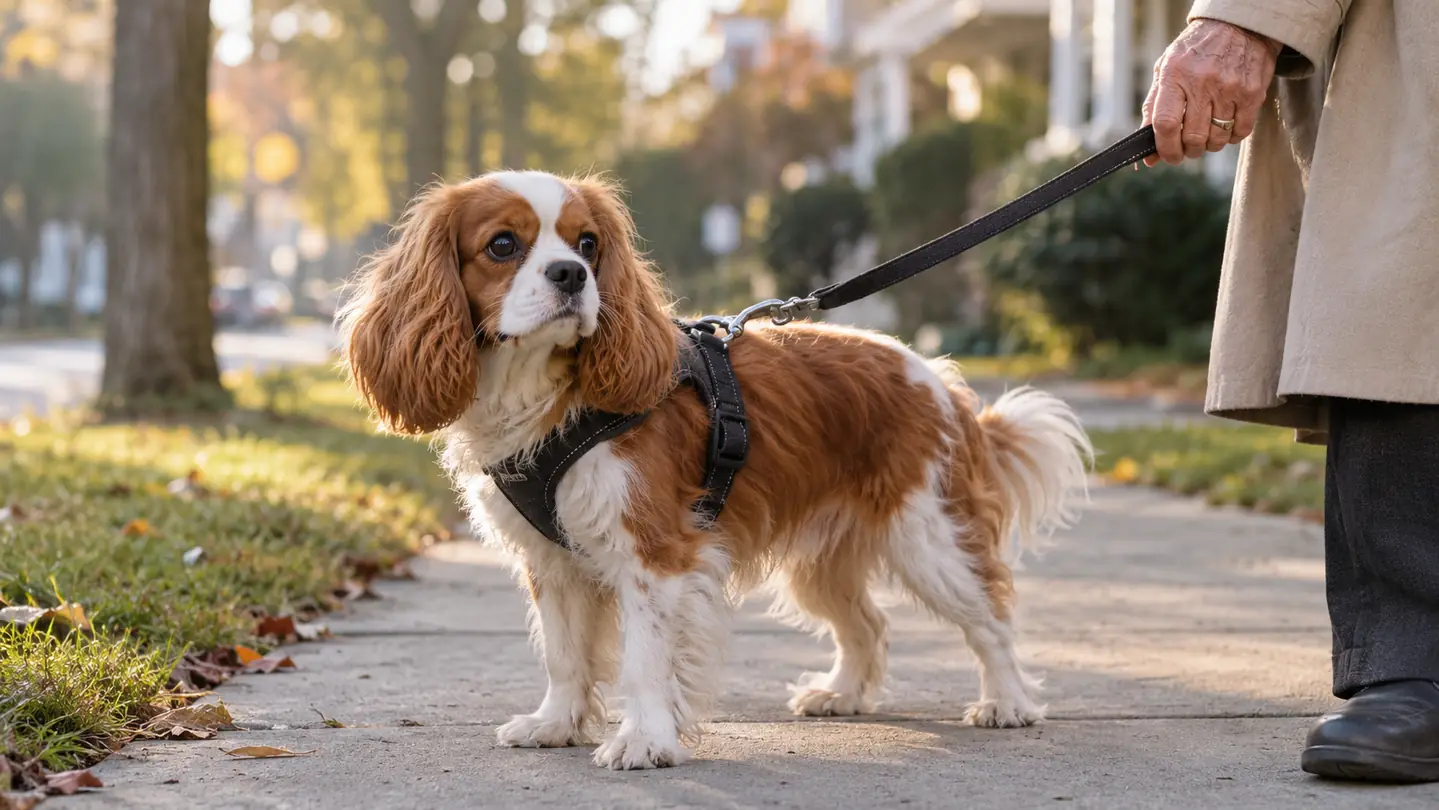
Nine days after I brought Pip home from the county shelter, a trash truck banged at the end of my driveway and he backed straight out of the flat nylon collar I had bought him at the pet aisle of the grocery store. He got two houses down and under Marge's hedge. It took about ten minutes and a piece of cheese to get him back, and he was not hurt. I sat on my kitchen floor afterward with my heart going, and then I got up and found my laptop. He is a terrier-Chihuahua mix, thirteen pounds, about four years old, tan with one white paw. I had owned him for nine days. Around eleven that night I ordered a Gooby Escape Free Easy Fit harness in a Small, an AirTag collar, and the AirTag itself. Ten and a half months and two walks a day later, he has not slipped the harness once.
If you are standing in the aisle with the same two things in your hands, here is the short answer. A martingale collar is a loop with a second, smaller loop that draws tight around the neck when a dog pulls backward, which stops the collar from sliding over the head. It is built for exactly the thing Pip did, and I am not going to pretend otherwise. A step-in harness closes the space around the back of the dog so there is less opening to back out of, and it puts the leash on the body instead of the neck. I bought the Gooby because Pip startles at noises, and a collar that tightens under his chin every time a delivery van goes by felt like the wrong conversation to have with a dog who was already afraid of the world. If your dog is calm and simply slips collars, a martingale is the more direct fix and probably all you need. If your dog panics, the harness is the one I would buy again tomorrow.
| Gooby Escape Free Easy Fit | Martingale collar | |
|---|---|---|
| How it stops a slip | The frame comes up around the back and closes the space a dog backs out of. The leash clips to the harness, not the neck. | A small loop draws tight around the neck the moment the dog pulls backward, so the collar cannot pass over the head. |
| Pressure on the throat | None. The strap crosses the chest and the leash ring sits on the harness, nowhere near his windpipe. | The loop is meant to tighten across the front of the chest and sit high on the neck to work at all. |
| Getting it on | Step-in. He puts his front paws through and I close one buckle. Pip froze at first and took a few weeks to stop. | Slips over the head in one motion. Nothing for the dog to step into and nothing to hold still for. |
| Everyday wear and tags | Pip wears his only for walks. It hangs on a hook by the back door the rest of the day. | It is a collar, so it stays on, and his license and ID tag hang from it around the clock. |
| Sizing a thirteen-pound dog | Small is listed for a sixteen to nineteen and a quarter inch chest. Pip measured seventeen, so the size was arithmetic. | Sized by neck measurement and adjusted at the slide, and it has to sit high on the neck to do its job. |
| Best for | A small dog who startles and backs up, on daily walks with the same person. | A dog who slips collars but walks calmly the rest of the time. |
Where the Gooby Harness Wins
Start with the throat, because that was the whole reason I could not make myself buy a collar that tightens for a dog who startles at every truck. When Pip pulls, the harness takes the pressure across his chest and the leash ring sits on the harness itself. He can pull, and he does pull when a squirrel is involved, and nothing closes on his windpipe. The escape-free part is a shape thing rather than a tightening thing: the frame comes up higher around the back and cuts down the space between his shoulder blades, so there is less of an opening to back out of. It does not clamp down on him to work. It just has less room to fail. Reading that on a listing is one thing. Feeling it on a dog who is already scared is another, and it is the difference I notice every single morning at my back steps, where the whole thing started. We do the same loop around the neighborhood twice a day, and I still look at Marge's hedge sideways when we go past it.
The other half of it is not really a design feature at all. It is that the leash clips to the harness every single time, no exceptions, no quick trip to the mailbox on the collar alone. I made that a rule the night he got out and I have not broken it. Before March, every walk was a negotiation with the neighborhood. A car door, a delivery van, a screen door slamming three houses down, and he would hit the end of the leash and spin. By about three months in, most of that had drained out of him. I am not going to sit here and tell you a piece of gear trained my dog. What I will tell you is that he stopped getting yanked in the throat every time he panicked, and the walks got quieter, and I think those two things are related. In ten and a half months he has never backed out of the Gooby, and I have not had that flash of cold in my stomach at the back door again.
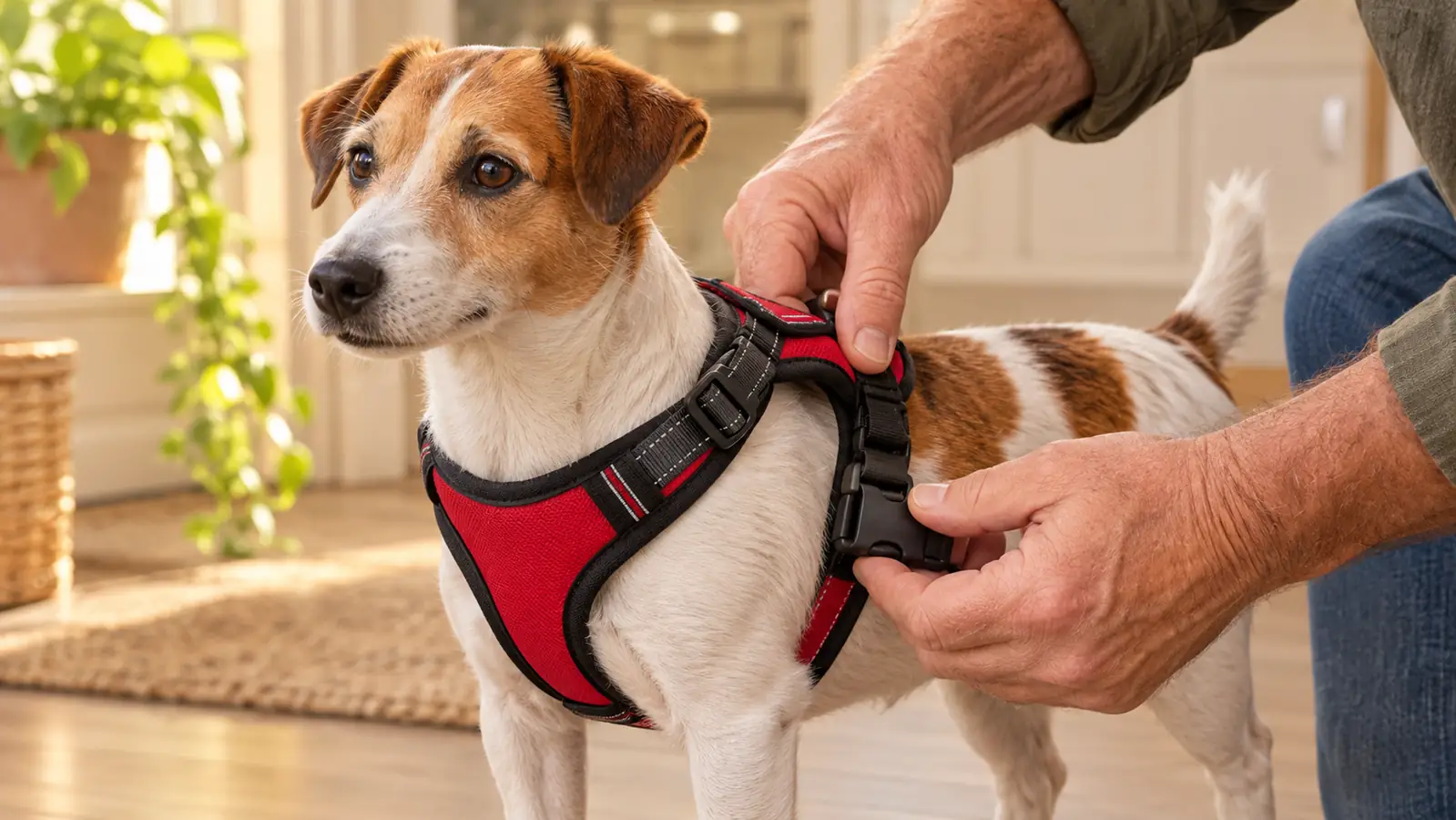
Two things I would tell you before you order one. Measure him first, with the tape from the kitchen drawer, around the chest at the widest point behind the front legs. I did that the night of the escape with a piece of cheese in one hand and the tape in the other, and I wrote seventeen inches on the back of an envelope, along with eleven for his neck, and then I sat at the kitchen table and read the size chart four times because I did not want to get this wrong twice in one week. The Small is listed for a sixteen to nineteen and a quarter inch chest, which is why I am not guessing at the size. The other thing is the step-in part. He has to put his own paws through the frame, and for the first few weeks Pip stood in the doorway and refused to lift a foot. I did not turn it into a fight. I put it on, we walked, I took it off. He got over it somewhere in the second week, and now he lifts a paw before I have the thing unfolded. The box came four days after the escape and I remember standing in the kitchen with it, still half expecting to be bad at this.
It weighs a little over two ounces, which I did not appreciate until I had it in my hand and realized it was lighter than the leash. The listing says machine wash cold and hang dry, and I have done that twice, once after a muddy walk in March and once in the summer, and both times it came out looking like it went in. On the fourth of July the fireworks were bad enough that he spent the evening in the donut bed in the bathroom with the radio on and me on the floor next to him, and the harness stayed on its hook by the back door the whole night, because it is a walking tool and that was not a walking night. It lives on that hook. I have never once had to go looking for it. For a person who misplaced her car keys twice last week, that counts for something.
Where a Martingale Collar Wins
I want to be fair to it, because it is good gear and it is not the villain of this story. A martingale is the direct answer to the exact thing Pip did. The small loop draws up when a dog pulls backward, the collar cannot pass over the head, and the dog stays attached. Every shelter I have walked through uses them, and the woman at the county shelter had one on the dog she was holding when I met Pip, which I did not think about at the time and have thought about plenty since. If I had a greyhound, or any dog whose head is narrower than its neck, I would not argue with the person who handed me one. It is one piece, it goes over the head in a single motion, and there is nothing for a dog to step into. Pip used to freeze when I put the harness on, standing there like I had asked him to solve a math problem, and a collar would have skipped that entire ritual. Sizing is by neck measurement and adjusted at the slide, and it has to sit high behind the ears to do what it is supposed to do, which is the part people get wrong the first time.
Where a collar genuinely beats a harness is the other twenty three hours of the day. Pip's harness comes off when we come in and hangs on a hook by the back door, because that is what it is for. His collar never comes off. It carries his town license and his ID tag, and if a door is left open, a collar is how a dog gets home. A harness does not solve that problem and mine does not try to. His has a small case on it that holds an AirTag I bought separately, and the little screwdriver that came in the box has been used exactly once, to put the tag in. I have checked his location from the library parking lot twice and from the grocery store once, with him at home the whole time, and it works best when there are other iPhones nearby. I have never had to use it for real. But the point stands: that collar is on him in the house, in the yard, and at two in the morning. The harness is on a hook. There is also less of it to keep track of, no buckle to line up, no paws to place. If I had a calm dog who had slipped a collar exactly once and walked politely the rest of the time, I would have bought the martingale and been done with the whole business in an afternoon.
Ten and a half months, two walks a day, and he has not backed out of it once. The collar before it lasted nine days.
What I Liked
- Takes all the leash pressure off a small dog's throat, which mattered more than anything else for a dog who startles
- The frame closes the space around the back, so there is less opening to back out of than a flat collar leaves
- Small is listed for a sixteen to nineteen and a quarter inch chest, and Pip measured seventeen, so the fit was exact
- Machine wash cold and hang dry, and at a little over two ounces he walks like he is wearing nothing
- One buckle to close, once his front paws are through the frame
Where It Falls Short
- He has to put his own paws in, and Pip refused to lift a foot for the first few weeks
- There is nowhere on it for tags, so a collar stays on him anyway
- In our house it is a walking tool only. It hangs on a hook by the door the rest of the day
- It does nothing about the dog who slips a collar in the house or the yard, which is a different problem
The one that held a thirteen-pound dog for ten and a half months
Small is listed for a sixteen to nineteen and a quarter inch chest, which is where Pip measured before I ordered. Step-in, one buckle, machine wash cold and hang dry. If your dog startles and backs up, this is what I would put on him.
Amazon Check today's price on Amazon →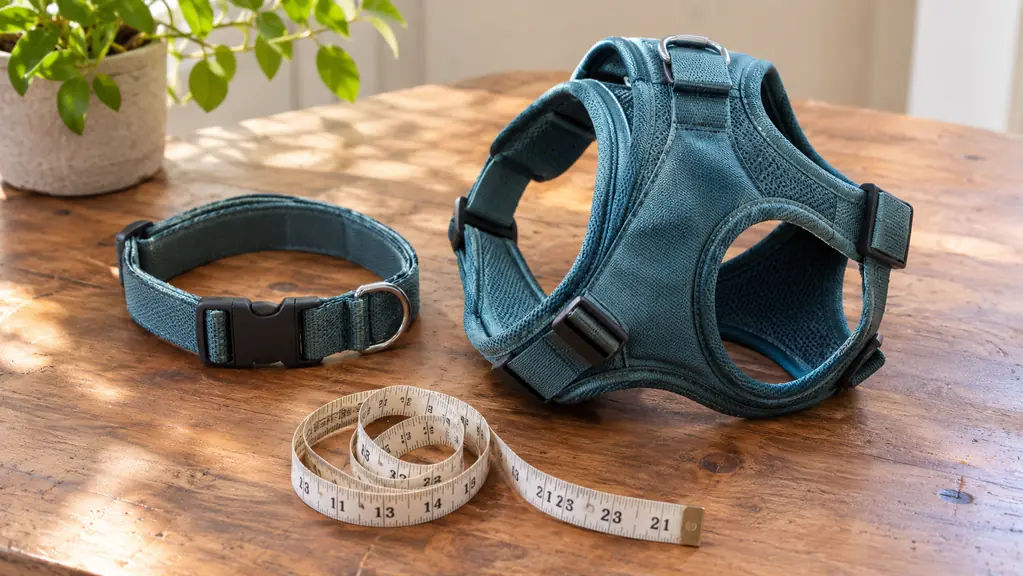
Who Should Buy Which
Buy the Gooby if your dog is small, if he startles, and if the moment you dread is the one at the back door when a noise goes off and he turns himself inside out. Buy it if you want the leash on his body and off his throat, and if you are willing to spend two or three weeks putting it on a dog who would rather not. Buy it after you have measured him, because the measurement is the whole trick. Pip is thirteen pounds with a seventeen inch chest and the Small is listed for sixteen to nineteen and a quarter. There is a weight range on the listing up to thirty five pounds, but I would go by the chest tape and not by the number on the box. I nearly ordered a medium because thirteen pounds sounds small to a person standing in her kitchen at eleven at night, and a medium would have hung on him like a coat off a hook. Order the size the tape says.
Buy a martingale if your dog slips collars but is otherwise unbothered by the world, or if his head is narrower than his neck, or if you want one thing that goes on in a second and stays on all day with the tags already hanging from it. Plenty of people use both, and I understand it now: the collar for identification and the harness for walking. I did not do that because he only wears one collar and it is the one with the AirTag on it, and I did not want a second thing to keep track of by the door. That is a preference, not a rule, and it is not a judgment on anyone standing in that aisle trying to get it right in week one. The one thing I would not do is put a martingale on a dog who panics and call it solved. I am not a trainer and I have no business telling anyone how to handle a frightened animal. What I know is what I saw at my own back steps: my dog hit the end of a leash, a collar would have snugged up around his neck, and he was already a dog who thought the world was out to get him. That is the whole reason the harness won in this house.
If your dog is the kind that backs up, put the leash on his body
Pip measured seventeen inches at the chest and wears the Small. Two walks a day for ten and a half months and it has never come off him on a walk. Measure first, then order.
Amazon See the Escape Free Easy Fit on Amazon →