Pip came home from the county shelter in the second week of December, and for the first three weeks I handled him like a piece of china. He was about four years old, a terrier-Chihuahua mix, thirteen pounds, tan with one white paw. Loud noises sent him under the kitchen table. Being left alone made him pace. The carrier was not on my mind until Dr. Amaral's office called to schedule his second visit. I had borrowed Marge's hard plastic crate for the first one, and it rattled the whole four miles. Pip shook for twelve minutes. That is when I ordered the Henkelion soft carrier.
I am not a trainer. I am sixty-two, I spent thirty years in a school office before I retired, and I live alone in Plymouth, Massachusetts with one dog. What I know about carriers comes from two weeks in January with Pip and a bag of chicken treats. The Henkelion carrier is 17 by 11 by 11 inches and rated to 15 pounds. Pip weighed 13. The first thing I learned is that a rescue dog does not care about the carrier. He cares about whether the carrier predicts a bad thing.
I want to be clear about what this is not. It is not a medical plan. Pip is a nervous dog, not a sick dog. If your rescue dog freezes, pants, drools, or tries to bite when you bring out a carrier, stop and call your vet. Dr. Amaral has told me more than once that real anxiety is not something I should try to train around on my own. That advice applies to you too.
The Carrier I Wish I Had Bought Before the First Vet Trip
I borrowed a hard crate for Pip's first visit. It rattled. In January, before his second visit, I ordered the Henkelion soft carrier. Start with it open on the floor, not zipped in the car.
Amazon Check Today's Price on Amazon →The Five Steps I Used
Step 1: Set the carrier out before you need it
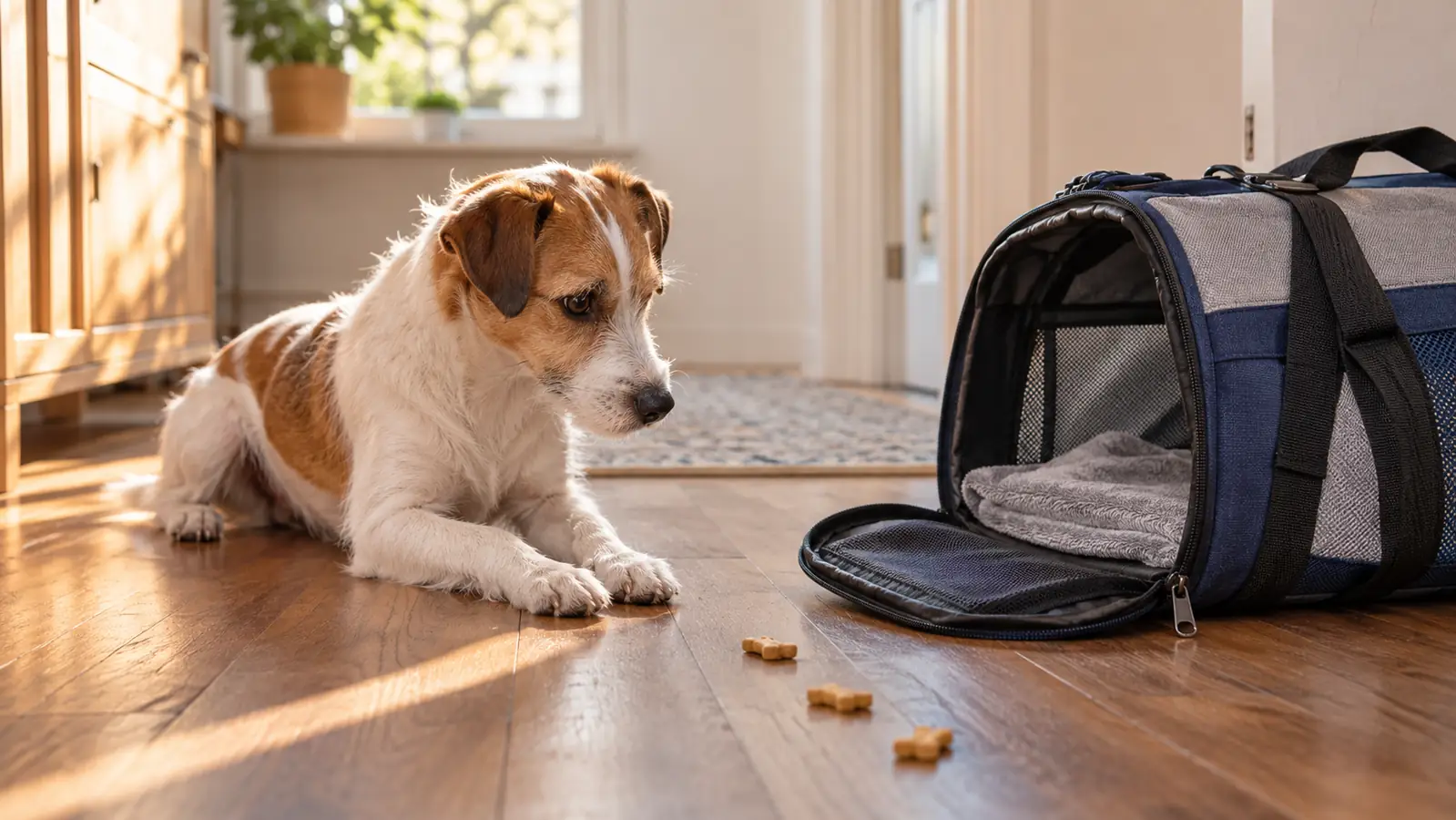
Step one is not about the car. It is about the floor. I put the Henkelion carrier in the living room with the zipper open and the shoulder strap folded under it so it would not flop. I did this on a Monday, two weeks before the appointment. Pip looked at it from the doorway and went back under the table.
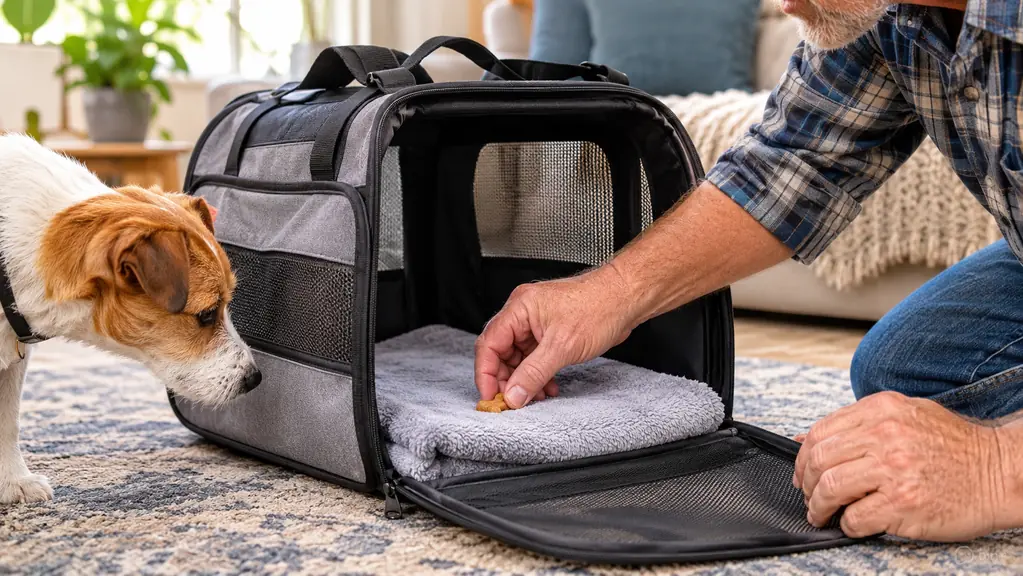
For the first three days he would not go in. I did not push. I dropped one small piece of cooked chicken near the opening, then just outside it, then an inch inside. The first day he took the treat and left. The second and third days he stayed away from it. That is normal. A rescue dog is not being stubborn. He is checking whether the floor is safe.
I kept the carrier in the same spot for all two weeks. I did not move it to the car and back. I did not zip it that first week. I did not pick it up while he was near it. The point is for the carrier to become furniture, not an event. If it only appears when something unpleasant is about to happen, that is the only thing it will ever mean.
I also left a worn towel in the bottom of the carrier. Not a bed, just a towel that smelled like the house. I did not wash it for the whole two weeks. It gave him something to sniff that was not brand new, which mattered more than I expected. New things have a smell. My house already smelled like home.
One more note on placement. I put it where I actually sit in the evening, not in a spare room. Pip wants to be in the room I am in. If the carrier is where the family is, it gets sniffed a hundred times a day without anyone doing anything. If it is in the back bedroom, it stays a stranger.
Step 2: Feed him at the open door, not in the car
On day four Pip put his head inside and stayed for a bite of chicken. On day six he stood in it with all four feet while I held the zipper open. I did not close the zipper that day. I did not lift the carrier. I just let him eat and walk out.
I used his regular breakfast kibble for some of this, not only chicken. I fed him a few pieces at the open door, then set his bowl just inside the opening. He ate with his back legs outside. That was fine. By the end of the first week he was walking in on his own to see if the bowl was there.
The mistake I almost made was rushing to the car because the appointment was close. If I had zipped him in on day four, I think he would have panicked. I had two weeks. I used both weeks. If you have less time, use what you have and make the steps smaller. Two short sessions a day beats one long one, and it beats a Saturday afternoon of forcing.
If your dog will not take food near the carrier, back up. Put the treat three feet away and work closer over days. A dog that is too scared to eat is not ready for the next step. That is not failure. That is information, and it is free information, so take it.
Step 3: Let him stand in it while it stays still
Day six was the first time he stood fully inside. I had the carrier on the rug with the zipper open. I sat on the floor beside it and read a book, which is a very good trick for a nervous person as well as a nervous dog. He came in, turned around, and came out. I did not touch the zipper. I did not say good boy in a high voice. I just let it happen.
Day eight I closed the zipper for three seconds while he was eating chicken inside. Then I opened it. He came out, shook himself, and looked at me. We did that once in the morning and once at night for four days. By day twelve he could stay in with the zipper closed for a minute. By day fourteen he lay down inside while I sat beside him. That was the day I knew we could try the car.
I did not use a clicker or a special word. I am not coordinated enough for that. I just kept my voice flat and my hands slow. Pip does better when I act like nothing important is happening. That is harder than it sounds when your heart is going and you have an appointment on the calendar, but it is the whole job.
Step 4: Practice the strap and the seat belt in the driveway
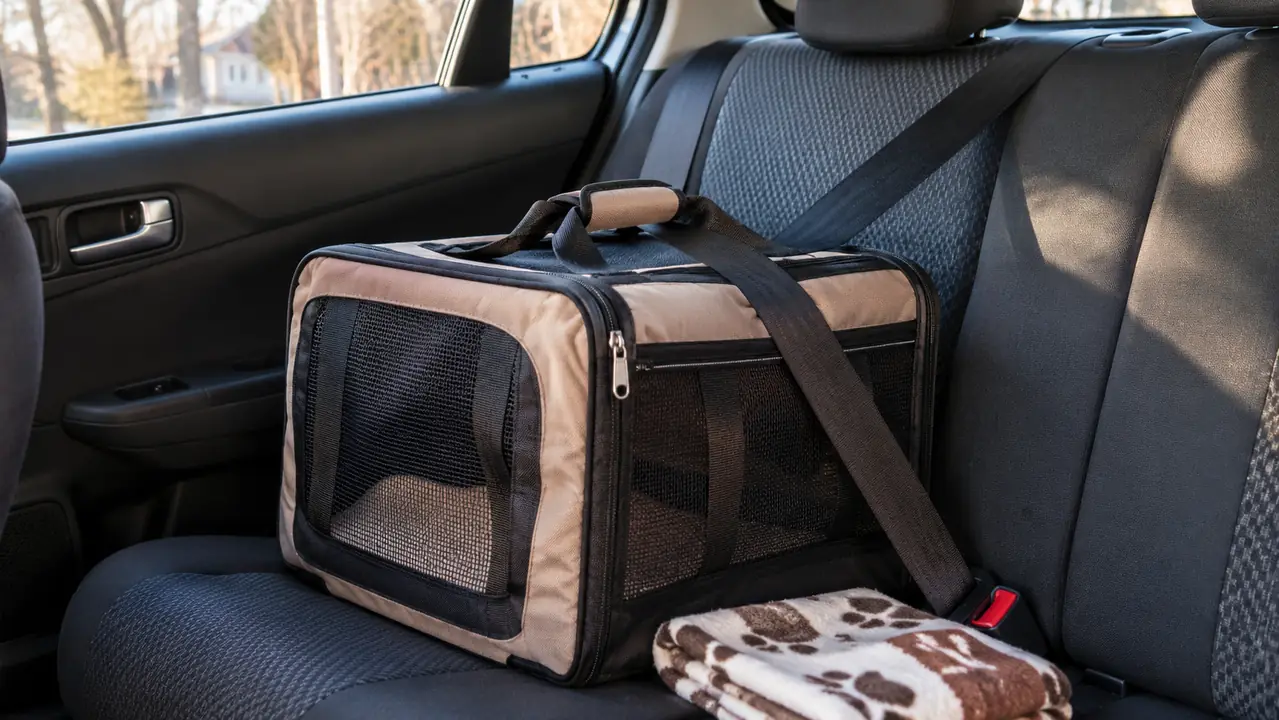
The Henkelion carrier has an adjustable shoulder strap and padded handles. I practiced picking it up empty first, then with a folded towel inside, so Pip could hear the strap move without being in it. Then I set it on the back seat of my hatchback with the engine off. I buckled the seat belt across the carrier and left the door open. Pip and I sat in the driveway for five minutes. Then we went back inside.
The next day I started the engine for one minute. The day after that I backed out of the driveway and pulled back in. I did not go to the vet on any of those days. The first real trip was four miles to Dr. Amaral's office, about twelve minutes, and I drove the speed limit like a person carrying a bowl of soup.
The carrier is listed as airline approved. I have never flown with Pip. I cannot tell you how that goes, and I would not pretend otherwise. I only know it fit in my hatchback, buckled in the back seat, and did not rattle like the borrowed hard crate.
If your dog howls in the driveway, go back to the living room for a few days. There is no prize for finishing the plan on schedule. A dog that howls in a parked car will not do better on the highway, and a bad first ride is the one you spend the next six months undoing.
Step 5: Make the first car trip short and boring
The first real trip was in January, a few weeks after the borrowed crate visit. I put the carrier on the back seat, buckled it, and put one treat inside. Pip walked in on his own. I zipped it, said nothing dramatic, and drove. He whined once at the stop sign and then settled. We were at the vet in twelve minutes.
At the office I carried the carrier by the handle, not the shoulder strap, because the strap swings. I set it on the floor in the exam room and unzipped it. I let Pip come out when he was ready. Dr. Amaral waited. The visit was ordinary. That is the goal. Ordinary.
The carrier has been to the vet three times now, in January, April, and September. It lives folded on a closet shelf between trips. I do not leave it in the car. A carrier that sits in a cold car stops being furniture and starts being the thing he only sees when something unpleasant is about to happen.
After the appointment I did not make a big deal. I put the carrier back on the closet shelf and gave Pip a piece of chicken in the kitchen. The next time he saw the carrier was three months later for the April visit. He walked in again. That is the only proof I have, and it was enough for me.
What Else Helps
The first thing that helped was having the carrier out before I needed it. I know that sounds like the same advice as step one, but it is the one I would repeat. The Henkelion carrier arrived in January, and I had it in the house for two weeks before the appointment. If you order it the night before, you have a box, not a plan.
The second was the harness. Pip wears his harness for walks, and the leash clips to the harness, never to his collar. I did not use the harness for carrier practice. What mattered was that he was already used to me handling straps and buckles without it meaning a vet visit. If your dog is not used to a harness, work on that separately. One piece of equipment at a time, or you will not know which one the dog is telling you about.
The third was the vet's office itself. I called ahead and asked if Pip and I could sit in the waiting room for five minutes without an exam. They said yes. We did that once in the summer, before his September visit. It was not a training session. It was a boring visit that ended with a treat and no thermometer. If your vet will not do that, ask if you can wait outside and pay at the desk. Most will work with you.
The fourth was silence in the car. I turned the radio off for the first three rides. Pip came to me from a shelter, and I have no idea what a radio sounds like to a dog who has never ridden in a car he could see out of. It cost me nothing to leave it off. We listen to the radio now. We did not the first three times.
What I Would Do Differently
I would start a week earlier. I ordered the carrier in January, but I did not put it on the floor until two weeks before the appointment, and even then the first three days were wasted because I was waiting for him to volunteer. A carrier can sit in the living room for a week before you ask anything of the dog. It just becomes part of the room.
I would also ask the vet for a quiet appointment time. Our January visit was at 9:10 in the morning, and the waiting room was full. Pip sat in the carrier by my feet and shook once when a large dog came in. The September visit was at 2:30 in the afternoon and the room was quieter. He did better. That is not a product fix. It is a scheduling fix, and it cost nothing.
One more thing. I would not wait for a crisis to try the carrier. The first visit with Marge's crate was a crisis. The second visit was a lesson. If you can make the first trip a five-minute ride around the block, do that. Pip did not get that. He got a real appointment. It still worked, but I would rather have practiced on a Tuesday with nowhere to be.
And I would write the days down. I kept a note on the kitchen calendar, because by the second week I could not remember whether he had stood in it on day five or day six. The dates are not the point. The point is that progress is slow enough to be invisible, and a calendar makes it visible.
Day fourteen was the first time Pip lay down inside the Henkelion carrier with the zipper open. That was the whole win.
Start With the Carrier Open on the Floor Tonight
The Henkelion carrier is 17 by 11 by 11 inches and rated to 15 pounds. Pip is 13. It has an adjustable shoulder strap and padded handles, and it folds flat for the closet shelf. Order it before the appointment, not the night before.
Amazon Check Today's Price on Amazon →