The first two Tuesday mornings I went back to my volunteer shift at the library, I came home to a dog who had not touched his breakfast. Pip is a terrier-Chihuahua mix, about four years old, thirteen pounds, tan with one white paw, and I adopted him from a county shelter last December. He came to me scared of loud noises and scared of the front door closing behind me. Leaving him was the part I could not fix with a better bed or a better collar.
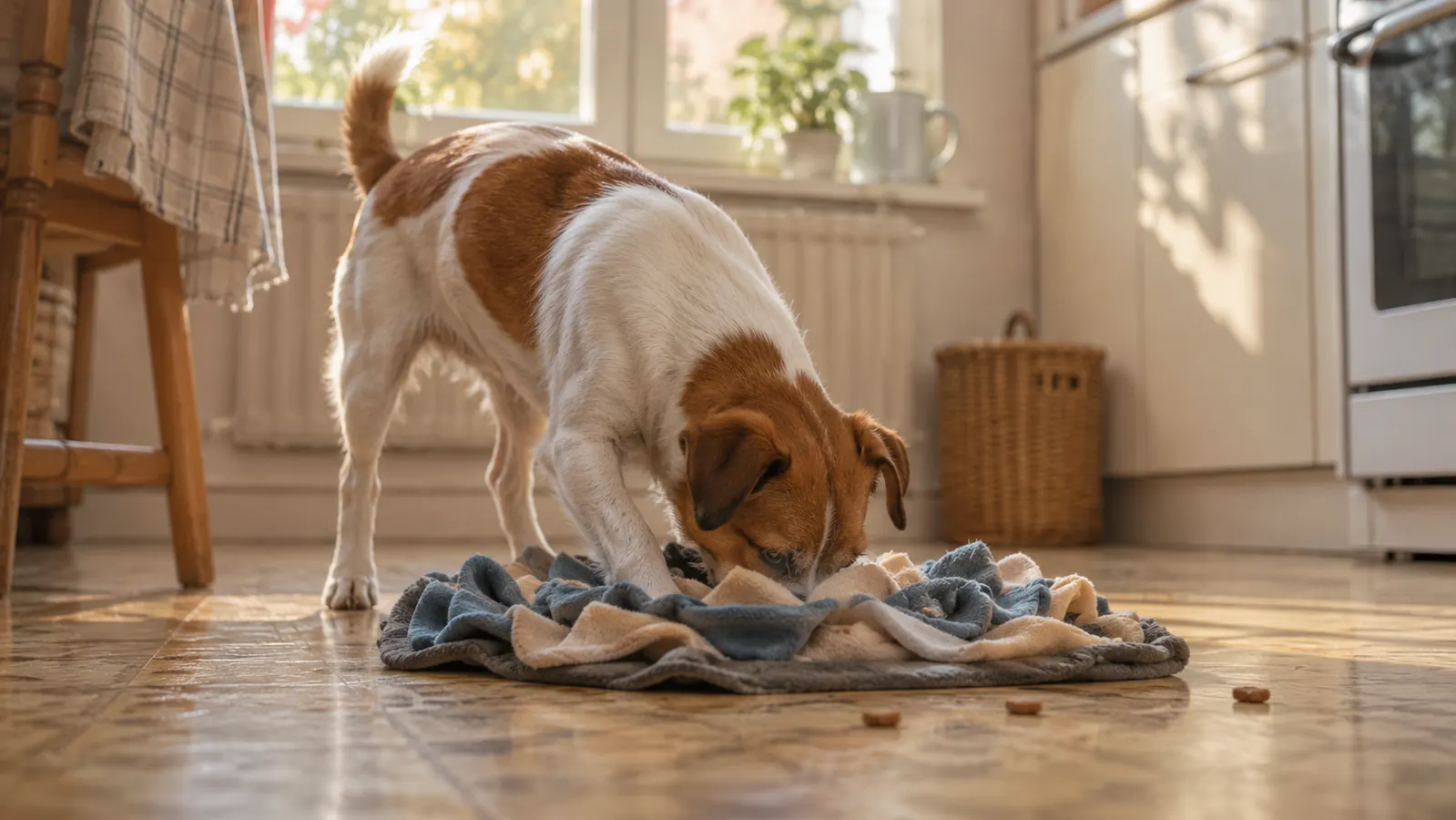
What fixed it, or at least made it a great deal better, was not complicated. It was his own breakfast kibble, scattered into a folded piece of fabric, put on the kitchen floor ten minutes before I walked out. That fabric is the AWOOF snuffle mat, and I have had it nine months now. This is how I use it, what went wrong at the start, and what I would tell you if you are standing in the pet aisle in your own first month, holding a rescue dog's leash and a shopping list.
The one thing that got my dog through his first alone mornings
This is the mat I put down on Tuesday and Thursday mornings. His kibble goes in, I walk out, and he has a job instead of a closed door.
Amazon Check today's price on Amazon →Why Leaving Is the Hard Part
Pip was not destructive. He has never shredded anything in his life. He was not a chewer, so the chew toy I left him sat on the kitchen floor untouched for weeks, and I could see it from the door when I got home, exactly where I had put it. He was just a dog with nothing to do and a person who had gone away.
The mistake I made first was thinking the fix would be a bigger goodbye. I fussed. I told him I would be right back. I made the leaving into an event, which is the opposite of what a nervous dog needs. The second mistake was assuming breakfast would happen on its own. He would eat at five in the afternoon when I got home, ravenous, and then want nothing at suppertime.
So the goal changed. Not to entertain him for three hours, which no toy does, but to give him the first ten minutes. Give a dog something to do at the exact moment the door closes and the rest of the morning tends to take care of itself.
Step 1: Measure Your Dog and Measure Your Morning
Before I bought anything else for Pip, I measured him with the tape from the kitchen drawer. Chest seventeen inches, neck eleven inches. I did the same thing with the mat, in a way. I measured the morning. How long would he actually be alone? Mine is about three hours, twice a week, Tuesday and Thursday. Not eight hours. Three.
That number mattered, because it told me what the mat had to do. It did not have to survive a full workday. It had to cover the window where he is most likely to pace, which for him is the first twenty minutes after the door shuts.
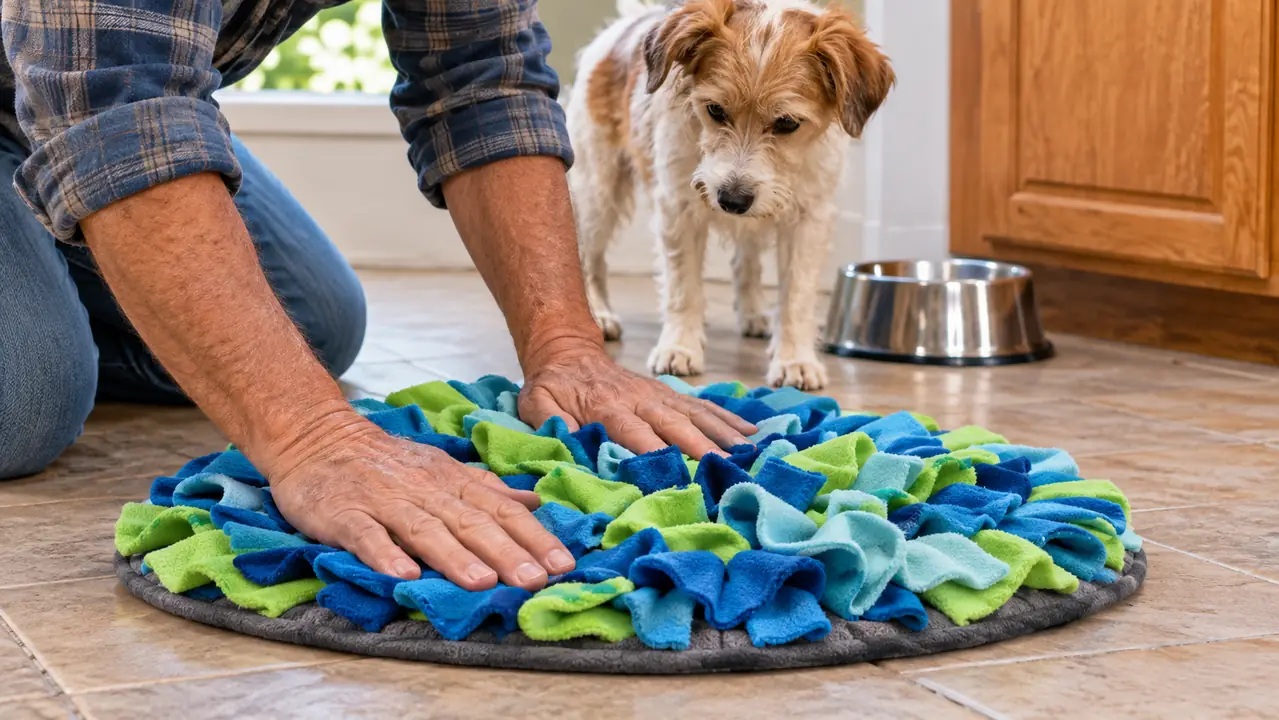
The AWOOF mat itself is 18.8 inches across and weighs about five ounces, so it is easy to lay out on my kitchen floor and easy to put away. It does not slide, because the bottom is a non-slip cloth. If your dog is a hard pusher at the mat, that grip is the difference between a puzzle and a game of tug.
Step 2: Use His Actual Breakfast, Not Treats
Here is the change that made the whole thing work. I stopped treating the mat as a treat and started treating it as a bowl. His breakfast kibble goes into it on those two mornings. All of it. Not a handful on top of a bowl of kibble, which is what I did the first week and which he solved in about ninety seconds.
That is the whole trick, and it took me a week to see it. A snuffle mat is only as much work as you make it. Toss kibble on the surface and you have invented a plate. Work it down into the folds so the dog has to push his nose through cloth to find each piece, and you have invented a job.
Start easier than you think you need to. The point is a dog who succeeds, not a dog who gives up. The AWOOF mat also folds into a bowl shape, though I use it flat and keep it flat in the cupboard by the back door.
Step 3: Set It Down, Then Leave Without a Speech
The order matters. Mat down first, kibble in second, then the door. Not the door first with a rushed scatter behind me. Pip needs to already be working when the lock turns, because a dog with his nose in cloth does not hear the door the same way.
And then I go. No long goodbye, no promise to return. I say the same three words every time and I leave. He gets a job and a closed door, not a performance.
I know how hard that is on the first morning. I stood on the other side of that door with my hand on the knob, listening, for a good minute longer than I needed to. Then I went out to the car and drove to the library and worried the whole way, and when I came home the kibble was gone.
Step 4: Give It Two Full Weeks Before You Judge It
The first week was a bust. Pip gave up within a minute. He sniffed the mat, found two pieces, and went and lay by the back door to wait. If I had stopped there, I would have told you the thing does not work.
By the second week he was working it. Now it takes him about ten minutes, and he checks the mat again after his walk, which I take as a compliment. Ten minutes is not three hours. It is not supposed to be. Those ten minutes are the part of the morning where he used to stand at the door and worry.
Give it a fortnight before you decide anything. A rescue dog does not have a lot of practice at being good at new things, and the first few tries are him learning that the cloth is where the food lives, not a puzzle he has failed.
Step 5: Clean It Every Single Time, and Keep It in the Rotation
This is the step people skip, and it is the one that decides whether you still have a usable mat in six months. Mine is felt cloth, it is not water resistant, and it collects saliva and crumbs. After every use I shake it out, and about once a week I hand-rinse it in the kitchen sink. Then it air-dries about a day.
It has never been in a washing machine or a dryer, and I would not put it in one. Nine months in, my AWOOF mat is still in one piece because it gets rinsed, hung over the sink edge, and then put back in the cupboard by the back door.
Keep it special, too. Mine comes out on Tuesday and Thursday mornings and no other day. If your dog gets the mat every day at four in the afternoon, it stops being a thing worth doing and becomes furniture. Mine is stored away between uses for exactly that reason.
Ten minutes is not three hours. It is not supposed to be. Those ten minutes are the part of the morning where he used to stand at the door and worry.
What Else Helps
The mat is not a substitute for a walk and I would not sell it to you as one. Pip gets two walks a day around the neighborhood, harness on, leash clipped to the harness and never to the collar. A tired dog is easier to leave than a bored dog, and no puzzle changes that.
A walk before you go is worth more than anything you leave on the floor. My two mornings start with the short loop at the end of the street and then breakfast in the mat.
I also own one lick mat, bought in the spring, used on weekends with a little plain yogurt. Pip finishes that in about five minutes, which is faster than the snuffle mat, and it goes in the freezer some Saturdays. The two do different jobs on different days and I have not needed a third thing. I do not think of the AWOOF mat as a travel mat either, even though the listing calls it portable. Mine lives in a cupboard and has never left the house. If you are weighing one against the other, that comparison is its own rabbit hole. What I will say is that the mat that holds dry kibble gets used twice a week on a schedule and the one that holds wet food gets used when I remember.
One more thing worth being honest about. None of this is medical. If your dog is genuinely panicking when you leave, not just pacing, that is a conversation with your vet, not a shopping trip. I am not a trainer and I am not a vet. Dr. Amaral is the one who told me to call her if the pacing turned into anything worse, and it did not, but I would not have known the difference on my own.
Two mornings a week, ten minutes of work, one less worried dog
Mine has been in the cupboard by the back door for nine months. Scatter in his breakfast and let your dog have a job.
Amazon Check today's price on Amazon →
Who This Is For
If you have a dog who eats fast, or a dog who paces after you leave, or a dog who ignores every chew toy you bring home, this is worth a try. It suited Pip because he is not a chewer and he is very food motivated, which is a combination that leaves a lot of toys on the floor.
It is also a good fit if you are out for a few hours, not a whole day. Three hours is my number. If you are gone nine, one mat of kibble is not going to carry that morning and you should be thinking about a walker or daycare, not a piece of cloth.
It works for a small dog on a kitchen floor, and the size is generous enough that I am not chasing it around the room. The listing rates it for large dogs and cats as well, which tells you how much mat you get. It is not a travel mat and I do not treat it as one. Mine lives in a cupboard.
Who Should Skip It
If your dog tears fabric when he is frustrated, skip it. Pip has never shredded anything, so I cannot tell you how the mat holds up to a dog who does, and I would rather you not find out on my recommendation.
If your dog is genuinely panicking when you leave, this is not the answer and it is not fair to either of you to pretend it is. Get your vet involved first. A puzzle feeder gives a calm dog something to do. It does not treat fear, and no product on a listing page should be asked to.
And if you want something to keep a dog occupied for a full afternoon, this is not it. It is ten minutes of good honest work and then it is done. I would rather tell you that plainly than have you buy it and be disappointed on the first Tuesday.