
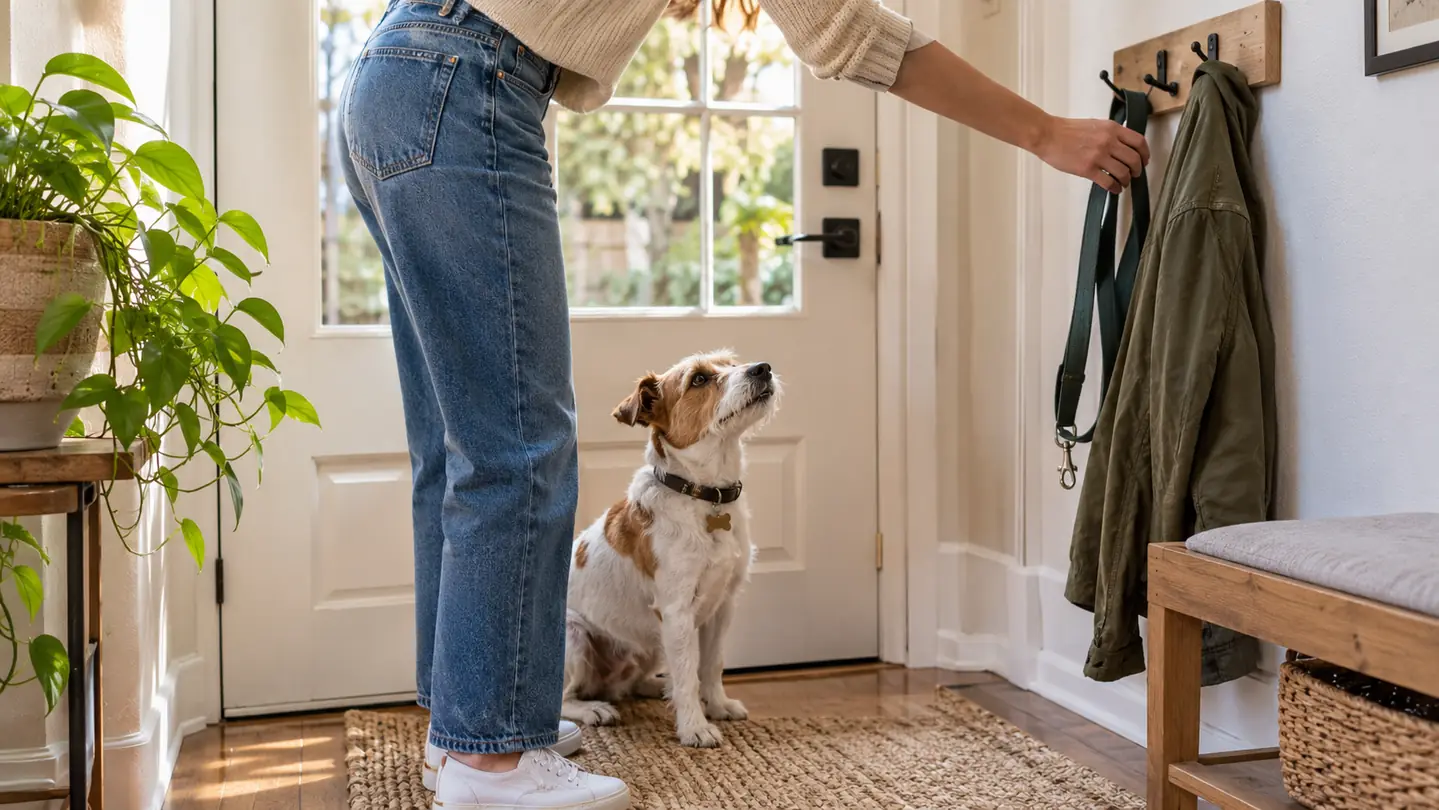
The Gooby Escape Free Easy Fit harness was an 11 p.m. purchase, made nine days after I brought Pip home from the county shelter. He was a four-year-old terrier-Chihuahua mix, thirteen pounds, tan with one white paw, and he had already learned that the back steps were the best place to become a blur. A trash truck banged. He backed straight out of the flat nylon collar I had bought in the pet aisle and ran two houses down to Marge's hedge. Ten minutes and a slice of cheese later, he was back in my arms, unhurt and shaking. I ordered the harness that night. Ten and a half months later, it still hangs on a hook by my back door, and he has never slipped it.
This is not a trainer's review. I am not a vet, a behaviorist, or anyone with a certification on the wall. I spent thirty years working in a school office before I retired, and I adopted my first rescue dog at sixty-two here in Plymouth, Massachusetts, and then spent the first month learning how much I did not know. What follows is what I wish someone had told me before I ordered the Gooby harness: the good, the fiddly, and the parts that will not solve every dog's problem.
The Quick Verdict
A lightweight step-in harness that made it much harder for my thirteen-pound escape artist to back out, but it is not a no-pull trainer and it needs a real fit check.
Amazon Check Today's Price →The harness I ordered at 11 p.m. is still the one by my back door
Ten and a half months, two walks a day, and Pip has not backed out of the Gooby yet. If your dog is a small escape artist, start by measuring his chest.
Amazon Check Today's Price on Amazon →What Nobody Tells You About a Step-In Harness
The first thing nobody tells you is that sizing is not about weight, even though the listing says the harness fits dogs up to thirty-five pounds. Pip is thirteen pounds, and that number would have told me nothing on its own. The size Small is built for a chest between sixteen and nineteen and a quarter inches. I measured him with the tape from my kitchen drawer before I ordered anything: seventeen-inch chest, eleven-inch neck. He landed inside the Small range with a little room, which is exactly where I wanted him. A friend with a stockier small dog could be under thirty-five pounds and still need a different fit. Measure the chest. Then measure it again.
The second thing is that step-in is a skill, not a magic trick. The dog puts his paws into the openings and you fasten the buckle. That sounds simple in a product description. In real life, the first week involved a dog who turned into a statue the moment the harness came near him. He did not fight. He froze. I sat on the kitchen floor and fed him tiny pieces of cheese while the harness sat on the floor beside us. Then I lifted one paw, then the other, and fastened it, and took it right back off. We did that for a few days before I asked him to walk in it. By the end of the first week, he was stepping in on his own because the harness meant a walk, and a walk meant smells and the neighbor's bushes.
Nobody tells you that escape-free does not mean escape-proof. Gooby's own description says the design reduces space around the back, which makes it harder for a small dog to back out. That matches what I saw. The harness sits closer to Pip's body than the flat collar ever did, and when he braces backward at a startling noise, there is not enough slack for him to slide out the way he did at the steps. But it is still a piece of equipment that has to be adjusted correctly. If you leave it loose because you are in a hurry, you have given the dog room to work. I check the fit every few weeks, especially after a wash, because a loose harness gives a dog room to work.
The last thing nobody puts on the label is that this is not a no-pull harness. Gooby does not list a front clip on this model, and I would not ask it to steer a hard puller. Pip is thirteen pounds and mostly interested in sniffing every fourth bush. The harness gives me a safe connection and a place to clip the leash. It does not teach him not to lunge at the mail truck. That lesson came from stopping, waiting, and walking the other way about four hundred times. The hardware is a POM plastic leash ring, not metal. For a small dog, that has been fine. If you have a dog who hits the end of the leash like a sled dog, this is the wrong tool for that job.
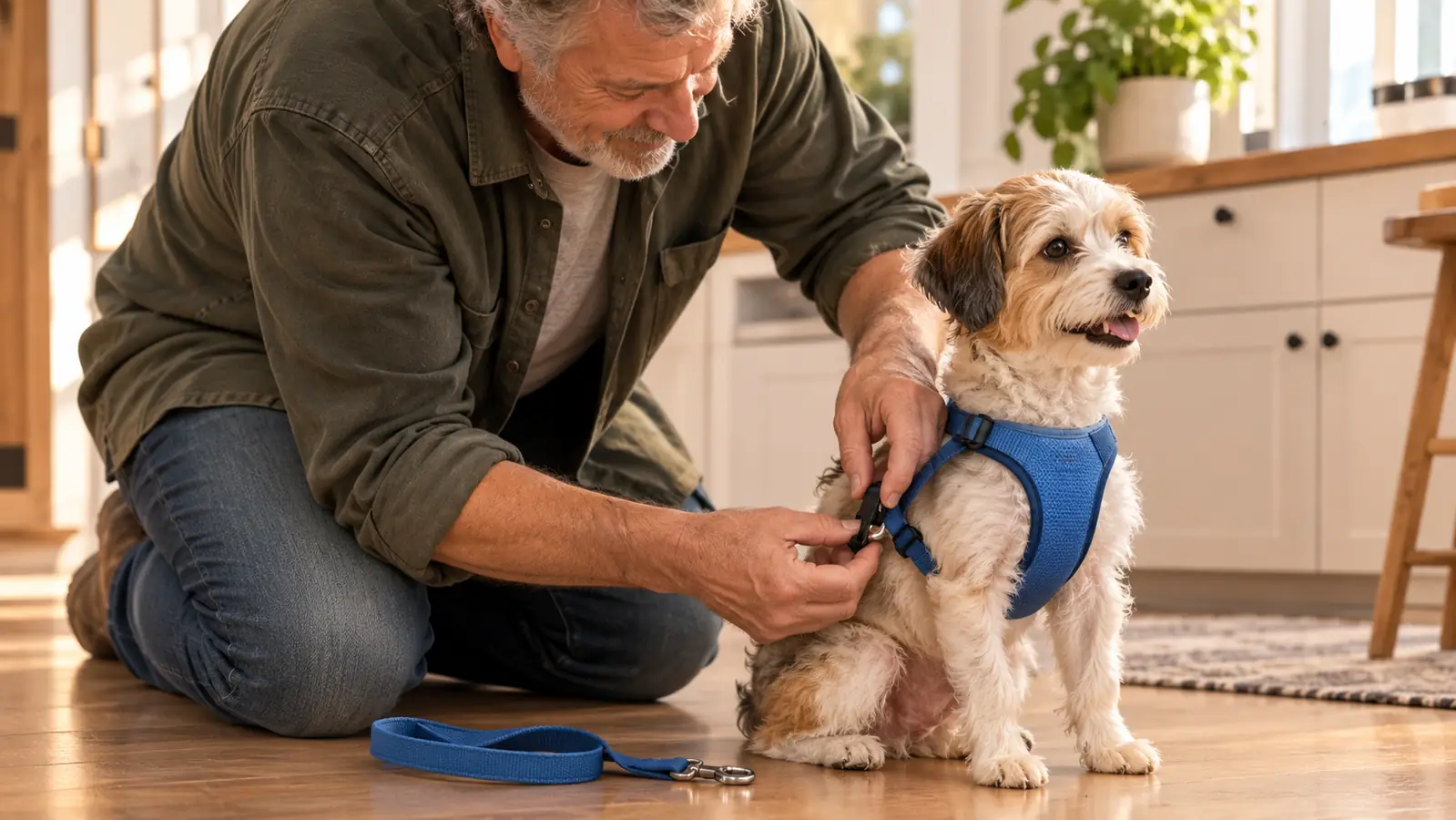
How I've Used It for Ten and a Half Months
The harness lives on a hook by the back door. It does not live on Pip. He wears it for walks and only for walks, which was a deliberate choice on my part. The leash clips to the harness ring, never to his collar. His collar carries his license and ID tag, and that is the collar's job. The harness has one job: keep the leash attached to a dog who has already demonstrated that he can leave a collar behind. Two walks a day, same neighborhood loop, same route past Marge's hedge. The hedge has become less interesting to him. The trash truck has not.
For the first few weeks, he walked like a dog wearing a small suitcase. His legs were stiff, his tail was down, and he stopped every ten feet to look back at me as if I had betrayed him. I did not drag him. I brought the cheese and made the first walks short, just to the end of the driveway and back. By March, about three months in, he had mostly stopped lunging at noises. I cannot prove the harness did that. It might have been time, or the routine, or the fact that he finally trusted that the back door meant a walk and not another ride to the vet. What I can say is that the harness never gave him a reason to fight me. It went on the same way every time, and he learned the sequence.
I have washed it on cold and hung it to dry, as the care instructions say. I did not put it in the dryer. It came out looking like the same harness, which is more than I can say for a lot of things in my laundry room. The whole harness weighs 2.24 ounces, so it is not adding weight to a thirteen-pound dog. On July 4th, when the fireworks started, Pip spent the evening in his bed in the bathroom with the radio on and me on the floor beside him. The harness stayed on its hook that night. I am telling you that because it would be easy to write a review where the product solves every scary thing. It does not. It is a walking harness.
One more thing about the walks. I keep the harness buckled exactly the way I took it off, so putting it on is one motion rather than a puzzle. That tiny habit has saved me more mornings than I can count. When Pip hears the buckle and steps forward on his own, I know the fit is still right. When he hangs back, something has shifted, and I check the straps before we go anywhere. He has never once been wrong about it. I have been wrong plenty.
The Sizing Detail That Matters More Than Weight
The size chart is the part I would tape to the inside of my cupboard if I were Gooby. Small is not a vibe. Small is a chest measurement from sixteen to nineteen and a quarter inches. Pip measured seventeen. He weighed thirteen pounds, which put him nowhere near the thirty-five-pound top of the range, but the range is not a weight range in the way people think. A dog can be under thirty-five pounds and still be too broad in the chest for this size. A dog can be over thirteen pounds and still fit the same size if the chest is right. I measured him on the kitchen floor with his front paws on a towel because he kept trying to eat the tape.
The harness is lightweight, 2.24 ounces according to the listing, with a buckle closure and a POM plastic leash ring. It is machine washable on cold if you hang it to dry. The warranty is one year from Gooby or an authorized dealer, which is the kind of detail I only noticed after I had already ordered. I am not going to pretend I compared warranties at eleven at night. I was looking for something that would keep a scared dog from backing out of a collar. But it is there, and it is worth knowing if you are the sort of person who keeps receipts.
The fit is not set and forget. I check the space around his back and under his chest every few weeks. If the harness feels loose, I fix the fit before we walk. If it is too snug, he lets me know by standing very still and looking at me with the patience of a dog who has already been through enough. The Gooby design gives less room around the back than a standard harness, which is the point, but that also means a bad adjustment is more noticeable. You are not just buying a size. You are committing to a thirty-second fit check before you leave the house.
What I Liked
- Step-in design became quick once Pip learned the routine
- Reduced space around the back made it much harder for him to back out
- Lightweight at 2.24 ounces, so it does not drag on a small dog
- Buckle closure is simple to fasten
- Machine washable on cold, hang dry
- Small size fits a chest from sixteen to nineteen and a quarter inches
Where It Falls Short
- Not a no-pull harness, and Gooby does not list a front clip on this model
- POM plastic leash ring instead of metal
- Step-in can be awkward with a dog who freezes or panics
- Needs regular fit checks, especially after washing
- Escape-free is not escape-proof if the harness is loose
- Not the right tool for a hard puller
What I Don't Love
The plastic leash ring is the first thing I would change if I could. It is a POM plastic ring, not metal, and it has held Pip for ten and a half months without a problem. But I grew up with metal hardware, and there is a small part of my brain that checks it every time I clip the leash. If you are the same, you will check it too. I have not seen it wear. I have not seen it bend. I am just telling you what it is, because a product page can make plastic sound like a dirty word and it should not. For a thirteen-pound dog, it has been fine.
The step-in design is also not a great match for every dog. Pip freezes, which is manageable. A dog who panics, twists, or snaps when handled may need a different style and a conversation with a trainer or vet. I am not going to tell you that a harness fixes handling issues. The escape-free design gave me a safer connection, but it did not turn Pip into a dog who loves being dressed. He tolerates it. He is happy once we are walking. That is enough for me.
The other limitation is that this harness does not steer. If your dog pulls hard, a front-clip harness or a training plan is a better place to start. Pip's biggest issue was backing out, not dragging me down the street. The Gooby solved the problem I had. It did not solve a problem I did not have. I think that is the honest way to say it. A lot of bad reviews come from people who bought the wrong tool for their dog, and a lot of bad purchases come from product pages that imply one harness can do everything.
Ten and a half months, two walks a day, and Pip has not backed out of the Gooby once. That is the whole review, really.

What I'd Tell You Before You Order
Measure the chest before you order. Use a soft tape, keep it snug but not tight, and write the number down. If your dog is between sizes, call the company or look for a fit guide rather than guessing. The Small range is sixteen to nineteen and a quarter inches. Pip was seventeen. That is the whole reason the harness fits.
Practice at home before you commit to a walk. Put the harness on the floor, let the dog sniff it, feed a treat, and fasten it for a few seconds. Take it off. Do that again the next day. The step-in motion is easier for the dog to learn when it is not happening at the front door with a leash jingling and a squirrel across the street. I used cheese because Pip would follow cheese into a volcano. You can use whatever your dog actually cares about.
Clip the leash to the harness, not the collar. That sounds obvious, but I have seen people clip to the collar because it is closer to their hand. The whole point of the harness is that the collar is not the thing holding the dog. Pip's collar is for his license and ID tag. The harness is for the leash. If you are worried about a dog slipping a collar, the harness is the backup, and the collar is the ID. Keep both on for walks. That is what I do.
Give it a fair adjustment period. The first week may look like a dog wearing a suitcase. The second week may look the same. By the third week, most dogs have figured out that the harness means a walk. If your dog is truly panicking, stop and get help. A harness is not a behavior plan. It is a piece of nylon and plastic that keeps a leash attached. The rest is patience, treats, and time.
Who This Is For
This is for the person with a small dog who has backed out of a collar or scared you at the back door. It is for a dog between sixteen and nineteen and a quarter inches around the chest, up to thirty-five pounds, who needs a step-in harness that reduces space around the back. It is for someone willing to measure, adjust, and practice. It is for a dog like Pip, thirteen pounds, four years old, a terrier-Chihuahua mix who came home from a county shelter in December and spent the first nine days learning that the back steps were a launch pad. Gooby made a harness that was harder for him to escape. That is a modest sentence. It is also the reason I can walk him without my heart in my throat.
Who Should Skip It
Skip it if your dog pulls hard enough to need steering. Gooby does not list a front clip on this model, and a plastic leash ring is not a training tool. Skip it if your dog panics when handled and you have not talked to a trainer or vet about a plan. Skip it if you want a harness you can put on once and forget, because the fit needs checking. Skip it if your dog is outside the chest range. Skip it if you are looking for a harness that will make an anxious dog feel calm. This is not a calming product. It is a walking harness. Pip still does not like the trash truck. He just cannot get out of the harness when it goes by.
If your dog is already a blur at the back steps, start with the measurement
Measure the chest, practice the step-in at home, and clip the leash to the harness. The Gooby Escape Free Easy Fit is the one I trust for Pip.
Amazon See the Gooby Harness on Amazon →