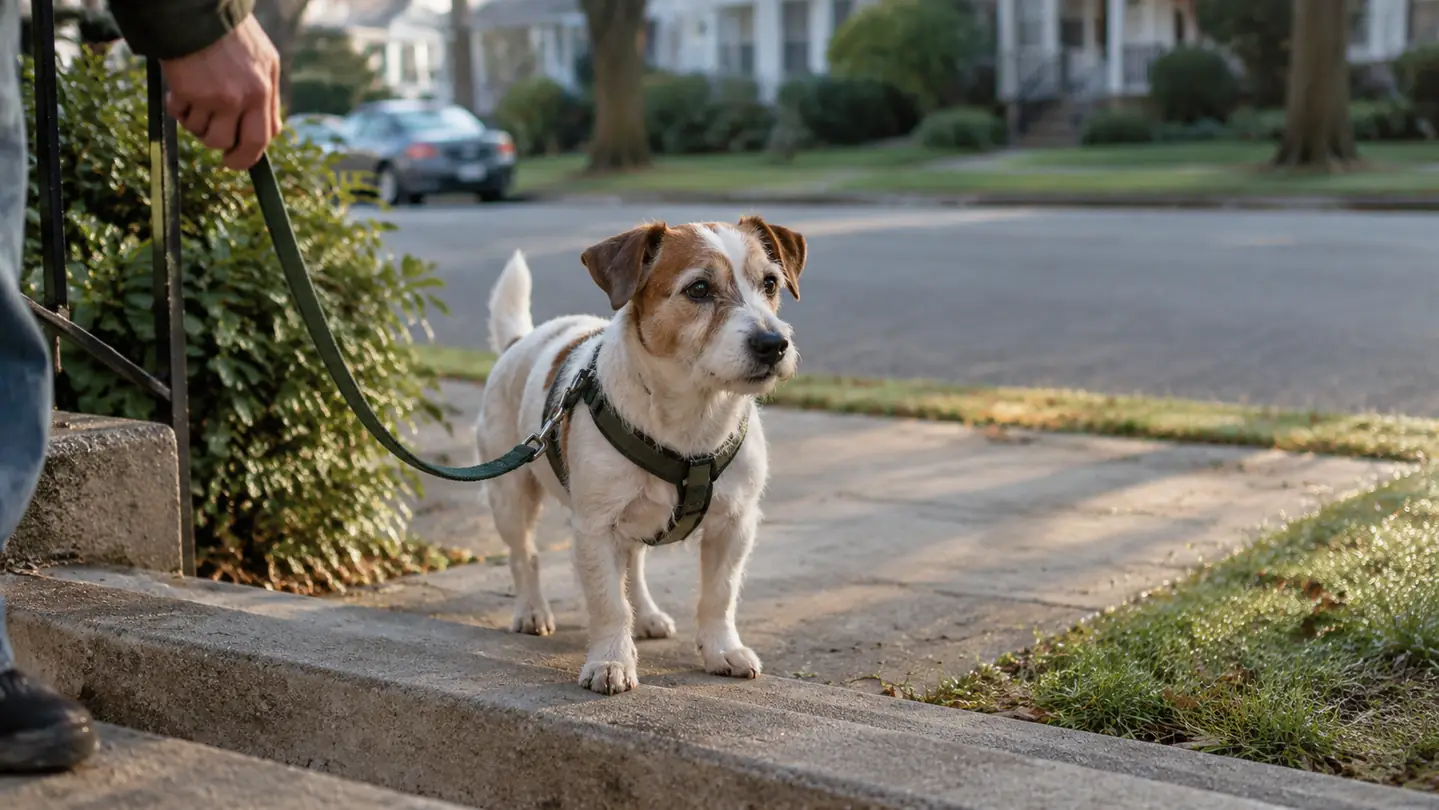
Nine days after I brought Pip home from the county shelter, a trash truck banged at the end of the street and he backed straight out of his collar. One second he was standing beside me at the back steps, the next he was a small blur heading for Marge's hedge two houses down. It took about ten minutes and a piece of cheese to get him back. He was not hurt. I sat on the kitchen floor that night with my phone and ordered the Gooby Escape Free Easy Fit harness at about eleven o'clock, and a collar that holds a tracker in a separate order, and then I sat there a while longer.
Here is the part I did not understand yet. A dog who bolts on a walk is not being stubborn and he is not trying to leave you. Pip was startled, and he did the only thing that had ever worked, which was to get small and back out of whatever was holding him. So the job in those first weeks is not training. It is making sure the thing holding him cannot be backed out of, and then making the walk dull enough that he has no reason to try. That is a hardware problem before it is a behavior problem, and it took me an embarrassingly long time to see it that way.
The harness that ended the backing-out problem in our house
The Gooby Escape Free Easy Fit is a step-in harness with a buckle closure and a leash ring on the back. Size Small fits a chest between 16 and 19.25 inches, and the whole thing weighs 2.24 ounces, so a small dog barely notices he is wearing it. Pip has worn his for every walk for ten and a half months. He has never slipped it.
Amazon Check Today's Price on Amazon →Step 1: Measure His Chest Before You Open a Single Tab
The tape measure lives in the kitchen drawer, so that is where I started. Chest at the widest point behind his front legs: seventeen inches. Neck: eleven inches. I wrote both numbers on the back of an envelope and left it on the counter, which sounds fussy until you are standing in a pet aisle trying to remember whether your dog is a small or a medium.
Gooby sizes this harness by chest measurement, and Small is cut for a chest between 16 and 19.25 inches. Pip at seventeen inches sits near the middle of that range and not on the edge, which is exactly where you want to be with a dog who is going to test the thing. The listing also gives a weight ceiling of 35 pounds. I want to be plain about this: do not shop by the weight number alone. Pip is 13 pounds. A round 20 pound dog and a long lean 20 pound dog do not take the same size, and the harness that is one size too big is the one a determined dog can fold himself out of.
What arrived within the week was a step-in harness that weighs 2.24 ounces and folds down to 6.5 by 9 by 1 inches. A light frame matters more than it sounds. Pip had already told me in nine days that anything bulky across his chest was a reason to plant his feet on the kitchen floor and refuse to move.
Step 2: Fit It in the Hallway With the Door Closed
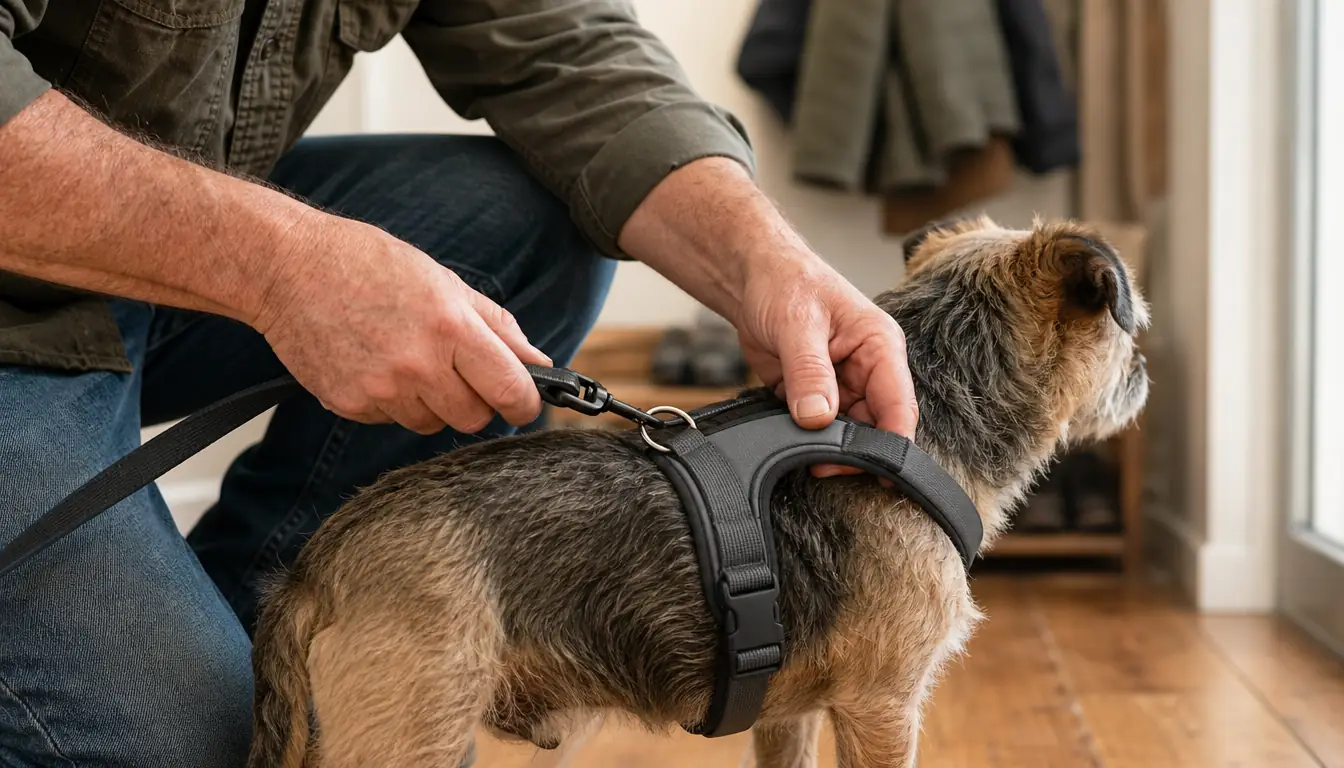
The first fitting happens in the house, with the door closed, and it happens before you have anywhere to be. Step-in means exactly that. He puts one paw in, then the other, you lift the panel up over his back and close the buckle at the back. The whole thing takes about four seconds once the dog cooperates, and considerably longer the first ten times. I did it on the hallway rug, because the rug keeps his feet from sliding out from under him, and that had been happening on the kitchen tile and making the whole business worse.
The reason this harness holds where a flat collar does not is geometry rather than tightness. The design takes up the slack around the back, so there is less room for a small dog to fold himself backward and slide out. That is the entire mechanism, and it is the one that mattered at my back steps. I did not need him to behave. I needed there to be nothing to back out of.
Then there is the part nobody warns you about, which is that he may hate it anyway. Pip froze for the first few weeks. Not fighting, not growling, just standing in the hallway like a statue with his ears down. So I stopped making it a production. On, count to ten, off, one piece of kibble, five times in a row, then put it away. Three days of that and he was walking to the hook by the door when he saw me pick it up. The freezing stopped being about the harness once the harness started predicting a walk.
Step 3: Clip the Leash to the Harness Ring and Leave the Collar Alone
The leash clips to the ring on the back of the harness. It does not clip to the collar, not ever, not for a quick trip to the mailbox at the end of the driveway. Clipping to a collar is how people end up where I was in December. The harness goes on or we do not go out.
Two checks before the door opens. The buckle is closed and sits flat, and I can get two fingers under the strap at his chest without the strap digging in. That is the fit check. This harness is a light frame, but light is not the same as loose, and a harness that slides around is a harness that is working its way toward an exit.
The leash ring itself is a POM plastic ring, which is worth mentioning because plastic is the thing people worry about. Mine has taken ten and a half months of two walks a day and shows no wear at the point where the clip sits. I still look at it. Every walk, a glance, the same way I check the buckle. That is not fear, it is just the habit that replaced the one where I trusted a flat collar.
Step 4: Rehearse the Bolt Before It Happens
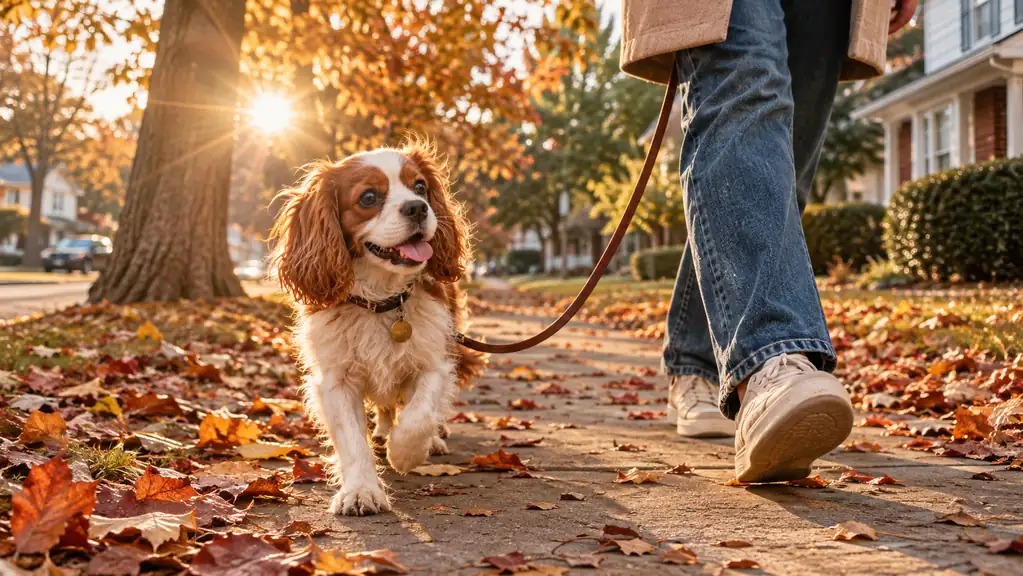
You cannot stop a startle. The trash truck is going to bang, somebody's screen door is going to slam, a kid on a bike is going to come around the corner too fast. What you can decide in advance is what your body does, because your dog is reading your posture and your pace far more closely than he is reading your voice. I learned this the slow way, standing at the corner with my arm out straight like a lamppost while Pip dug in and stared at a plastic bag.
What I do now: plant my feet and stop. I do not pull forward and I do not reel him in, because forward pressure is the exact cue that tells a scared dog to keep going backward. I wait a beat, then I turn and walk the other way, which gives him something to move toward instead of something to get away from. When he glances back at me, he gets a piece of cheese. Cheese, not praise, because praise is not what got him out from under Marge's hedge. The other thing I did was listen for the trash truck, and on mornings I could hear it coming we waited a few minutes before heading out.
By March, about three months in, he had mostly stopped lunging at noises. Not because of one clever move. Because nothing bad had happened on a walk about two hundred times in a row, and he had stopped expecting it to.
Step 5: Make the Same Walk Boring on Purpose
Same two walks a day, same route, same order. Around the neighborhood and home. There is nothing interesting about our walk and that is exactly what makes it work. An anxious dog does not need variety. He needs to be able to predict the next ninety seconds, and he needs that to be true on a Tuesday in February as much as on a Saturday in June. The week I changed the route to keep things fresh, Pip spent the entire walk scanning for whatever was coming next.
The harness hangs on a hook by the back door and it only comes off that hook for a walk. This is the smallest change I made and the one that helped most. The collar stays on all the time, and that collar is his identification: license and ID tag on it, never on the harness. Two pieces of equipment, two jobs, no overlap. The hook means walk and nothing else. The carrier is for the car.
End the walk before he is done, not after. Twelve minutes of a calm dog is worth more than thirty minutes of a dog who is over his limit and still has to get home. And when the harness needs washing, which for us is about once a month in mud season, it goes in the machine cold and hangs to dry. It has held up fine through a winter of that.
What Else Helps
The one thing I would add, if you have a dog who has already gotten loose once, is a second way to find him. Pip wears a collar with a tracker case every hour of the day, and it carries his license and ID tag. I have never had to use it to find him. I have tested it three times, twice from the library parking lot and once from the grocery store while he was home, and it puts him at the house. It works best when there are other phones nearby, which on our street there usually are. I decided against a subscription tracker after reading about the monthly fee. That is a choice, not a warning.
The other thing, and I say this as a person who is not a trainer and not a vet: if your dog is shutting down at ordinary sounds, call your vet. Dr. Amaral's office is four miles from my house, about twelve minutes by car, and I have asked her questions on the phone that I felt silly asking. Ask about real anxiety and what it looks like, because a harness solves the slipping and nothing else. It will not make a frightened dog brave. It just makes sure that when he is frightened, he is still on the leash.
What I would skip: a retractable lead, a head halter, a second harness in a different style, anything with a bungee in it. One six foot flat leash and one harness that fits, and then the same walk over and over until it is dull. That is the whole method. It is not a fast one. But Pip has not been loose since that day in December, and the two of us walk twice a day without either of us thinking much about it. If you take one thing from a person who got this wrong for the first nine days: buy the harness before you need it, not after.
He slipped a flat collar exactly once, nine days after I brought him home. He has never slipped the Gooby, across ten and a half months and two walks a day.
One harness, one flat leash, and the same walk twice a day
The Gooby Escape Free Easy Fit is a step-in harness for small dogs up to 35 pounds, sized by chest measurement, with a buckle closure and a leash ring on the back. Machine wash cold, hang dry. Pip has worn his on every walk since December and he has never backed out of it.
Amazon Check Today's Price on Amazon →